The economic recovery is still some way from demonstrating it is fully on the road to recovery. Last week's budget may have had a mix of good and bad news but data from many market categories indicates that growth is a long way off.
We are involved in a number of markets. And can track short term variations in demand. Our observations showed that Autumn 2010 started poorly when a flood of bad news from the Conservative party conference depressed business and consumer markets. This news centred on the the so-called better off having to share the pain of paying for the deficit. Essentially anybody earning £42,000 was designated as rich. Effectively, families with a single wage earner on £42,000 were being asked to pay more so that the army of public sector workers and client state benefit claimants could carry on receiving their over generous transfer payments. The budget seems to have replicated the depressive impacts on many markets.
Bads news from a whole series of markets now seems the norm. With profit warnings and senior director dismissal being a regular feature of the newsflow.
I await some good news.
31 March 2011


18 March 2011
Nike Losing in the Sports Brand War?
 |
| Welsh Rugby Player Jamie Roberts Wearing Under Armour |
Nike's sports brand positioning has been unchallenged over the past two decades facing down Adidas, Puma and Reebok. The new environment is more challenging and I suspect that this latest downturn in the companies financial performance may be more than a blip.
10 March 2011
UK Families Are Highest Taxed in OECD
A new report shows that UK families with one employed parent are the most highly taxed in the OECD. A family earning £33,745 will pay 39% more tax than the average for 33 other OECD countries.
The report has provoked charities, as well as economists, into attacking the UK governments ant-family stance. In essence, Britain is punishing middle income families in order to fund a benefits system that encourages workless families to remain dependent on state handouts.
As we know, price inflation is now rising faster than incomes. In addition taxation in the form of higher VAT and national insurance is hitting family incomes even harder.
Fuel bills, fares to work, basic food stuffs, rent or mortgages, council tax and water rates have to be paid. Families have to look to make ends meet so discretionary spending has to be cut and savings have to be made. One area that is now under scrutiny is money spent on things such as family holidays and and another is children's parties. In recent years these items of expenditure are no longer considered luxuries. In each case families will be looking for value for money.
The UK government should take a look at other systems of family taxation. The gap between working families and those where everyone is dependent on the state has shrunk. In many cases families gain very little from gainful employment. This trend needs to be reversed.
The report has provoked charities, as well as economists, into attacking the UK governments ant-family stance. In essence, Britain is punishing middle income families in order to fund a benefits system that encourages workless families to remain dependent on state handouts.
As we know, price inflation is now rising faster than incomes. In addition taxation in the form of higher VAT and national insurance is hitting family incomes even harder.
Fuel bills, fares to work, basic food stuffs, rent or mortgages, council tax and water rates have to be paid. Families have to look to make ends meet so discretionary spending has to be cut and savings have to be made. One area that is now under scrutiny is money spent on things such as family holidays and and another is children's parties. In recent years these items of expenditure are no longer considered luxuries. In each case families will be looking for value for money.
The UK government should take a look at other systems of family taxation. The gap between working families and those where everyone is dependent on the state has shrunk. In many cases families gain very little from gainful employment. This trend needs to be reversed.
23 February 2011
High Vehicle Costs and Petrol Allowances
The HMRC allows 40p per mile for travel costs when using a car for business purposes. The rate of 40p per mile was set in 2002 when a litre of unleaded cost an average of 77.9p. Today the average cost of a litre is around £1.30, representing a rise of 68%. The rise in vehicle costs without a commensurate rise in travel allowances means the role of vehicle tracking systems becomes ever more crucial. Every additional and unnecessary mile driven adds unnecessary costs.
I use my own car for business trips. Tomorrow I am to make a business trip of around 264 miles. My mileage allowance will be £105.60. Back in 2002, at 33 miles per gallon my petrol costs would have been £28.29, leaving £77.31 to cover both the variable costs and a contribution towards the shared fixed costs of car ownersip. Tomorrow my petrol costs will be £47.22, leaving just £58.38 towards other costs. Even if all other costs had stayed the same since 2002, I am left with a 24.5% shortfall. I am probably, therefore subsidising my employer.
A quic estimate of the true costs of the trip - based on its share of my annual mileage - indicates a fairer mileage contribution would be nearer 65p per mile. I drive about 9,000 business miles per year and further 4,000 miles on private mileage. At current mileage rates and petrol costs it would appear that I am subsidising my business to the tune of £2,250 per annum. The daft thing is, if my business was to compensate me for these increased costs I would need to pay tax on them as a benefit. If the HMRC fails to raise mileage rates I foresee increase demands to bring back company vehicles.
I use my own car for business trips. Tomorrow I am to make a business trip of around 264 miles. My mileage allowance will be £105.60. Back in 2002, at 33 miles per gallon my petrol costs would have been £28.29, leaving £77.31 to cover both the variable costs and a contribution towards the shared fixed costs of car ownersip. Tomorrow my petrol costs will be £47.22, leaving just £58.38 towards other costs. Even if all other costs had stayed the same since 2002, I am left with a 24.5% shortfall. I am probably, therefore subsidising my employer.
A quic estimate of the true costs of the trip - based on its share of my annual mileage - indicates a fairer mileage contribution would be nearer 65p per mile. I drive about 9,000 business miles per year and further 4,000 miles on private mileage. At current mileage rates and petrol costs it would appear that I am subsidising my business to the tune of £2,250 per annum. The daft thing is, if my business was to compensate me for these increased costs I would need to pay tax on them as a benefit. If the HMRC fails to raise mileage rates I foresee increase demands to bring back company vehicles.
04 January 2011
VAT Rise - Retail Prices Up by 5 to 8%
UK VAT rose from 17.5% to 20% today. This means a whole range of goods and services will go up in price. The UK Government has introduced the tax rise in an attempt to raise £13 billion and close some of the £160 billion annual deficit it inherited from Labour.
The Daily Telegraph points out that many retailers will increase their prices by far more than the 2.1% net increase the tax rise should bring. It reports that many retailers will round up prices rather than round them down. It quotes examples of mobile phone tariffs going up by 10 and 20%. It also quotes the examples of Fitness first that has put up monthly subscriptions by 25% in some cases. I have personal experience of the Fitness First rise where a I received a letter informain me of 30%. I raised the matter with my local gym and have downgraded my membership in order to retain the old price.
The Daily Telegraph points out that many retailers will increase their prices by far more than the 2.1% net increase the tax rise should bring. It reports that many retailers will round up prices rather than round them down. It quotes examples of mobile phone tariffs going up by 10 and 20%. It also quotes the examples of Fitness first that has put up monthly subscriptions by 25% in some cases. I have personal experience of the Fitness First rise where a I received a letter informain me of 30%. I raised the matter with my local gym and have downgraded my membership in order to retain the old price.
10 December 2010
Sterling Strongest Currency Tip for 2011
Barcap, the securities trading arm of Barclays Bank, has tipped the UK currency to to be the world's strongest in 2011. The pound has fallen 20% since the Banking crisis began in September 2008. Specific forecast rates of $1.82 and euro 1.28 is given for the end of 2011. Sterling closed at $1.58 today. This implies a rise of 15% against the Dollar and 7% against the Euro. Barclays is also bullish about the UK stockmarket, forecasting a rise of 18% in the FTSE.
26 October 2010
Banks Should Be Broken Up - Mervyn King
Mervyn King, the Governer of the Bank of England, has advanced the argument that banks should be broken up. The message came in a speech made in New York. In a section of his speech that specifically referred to the relationship between investment banking and retail banking King said that the only way to guaranee the assets of depositors was to separate them from more risky assets.
Over recent years traditional high street banks have increasingly involved themselves in investment. Whilst short-term profits may be earned from speculative deals, the activity also exposes banks to risking their whole deposit base. Halifax Bank of Scotalnd and Royal Bank of Scotland were both on the verge of collapse due to their exposure to investment banking. Only the UK government's need to protect retail depositors saved the two major banks from collapse.
Over recent years traditional high street banks have increasingly involved themselves in investment. Whilst short-term profits may be earned from speculative deals, the activity also exposes banks to risking their whole deposit base. Halifax Bank of Scotalnd and Royal Bank of Scotland were both on the verge of collapse due to their exposure to investment banking. Only the UK government's need to protect retail depositors saved the two major banks from collapse.
25 October 2010
Payday loans for quick money – but pay back promptly!
Research by watchdog Consumer Focus says that 1.2 million people are taking payday loans every year collectively borrowing more that £1million. That is almost four times the number of people from four years ago. As the number of people struggling to make ends meet on a monthly basis is growing, payday loans are increasingly a short term solution for people finding it hard to secure finance. And surprisingly, this kind of borrowing may be a better solution than paying your bank or a credit card company for expensive unauthorised overdrafts. As long as you comply with one rule – pay back promptly at the next payday!
Loans on offer are typically from £50 - £1,000 depending on provider. They are available online, quick to apply for and you could have the money in your account within an hour. Charges for these types of loans range on average from £13 to £18 interest for every £100 borrowed. However, if the loans are rolled over, the debts will increase sharply as interest charges rise.
The most unscrupulous companies are charging interest rates of more than 2,500% a year. As a result, the watchdog is urging the industry to bring in more protection for vulnerable borrowers. Outlawing payday loans could leave some borrowers vulnerable to illegal loan sharks. Instead sensible safeguards would stop borrowers becoming dependent on this kind of high cost credit and prevent even more stringent controls being needed in the future.
Sarah Brooks, head of financial services at Consumer Focus, commented: “Payday loans are a valid form of credit and it’s much better for people to take one out rather than go to a loan shark. But we do think there needs to be a limit on the number of loans people take out and how many loans they are able to roll over,” she explained. Maybe banks could also develop a valuable service and benefits all around by providing an alternative short-term credit to suit the needs of cash-strapped consumers?
Click the post title to listen to a BBC radio interview of Sarah Brooks on the subject of payday loans.
21 October 2010
Has Osborne Cut Enough from Public Spending?
I have just read Jeff Randall's contribution to tomorrow's Daily Telegraph. After reading the article, that points out that Osborne's cuts in spending will only get public expenditure back to 2006-7 levels. And that is not until 2014.
What is shocking about the whole issue is the belief by much of the population - especially those outside of the south and midlands of England - that they are somehow entitled to take money whether they deserve it or not. On last night's TV I watched a woman from Swansea moan about the fact she had lost the child benefit of a daughter who had left school. Why she posited should she not carry on getting this benefit. Her rationale, and that of the TV narrator, appeared to be that she lived in Wales. And that because of the local economy, they were somehow entitled to money, whether earned it or not.
Even Jeremy Paxman joined in. Constantly complaining to Treasury Secretary Danny Alexander about the poorest 10% of the population, almost all of whom live entirely on benefit and have therefore enjoyed inflation-linked rises in tax free income over the past three years, whilst almost everyone in employment has seen their real incomes diminish in value.
Yes it's time to cut. But I do not believe Osborne has gone far enough in cutting the waste that is central to much of the public sector.
What is shocking about the whole issue is the belief by much of the population - especially those outside of the south and midlands of England - that they are somehow entitled to take money whether they deserve it or not. On last night's TV I watched a woman from Swansea moan about the fact she had lost the child benefit of a daughter who had left school. Why she posited should she not carry on getting this benefit. Her rationale, and that of the TV narrator, appeared to be that she lived in Wales. And that because of the local economy, they were somehow entitled to money, whether earned it or not.
Even Jeremy Paxman joined in. Constantly complaining to Treasury Secretary Danny Alexander about the poorest 10% of the population, almost all of whom live entirely on benefit and have therefore enjoyed inflation-linked rises in tax free income over the past three years, whilst almost everyone in employment has seen their real incomes diminish in value.
Yes it's time to cut. But I do not believe Osborne has gone far enough in cutting the waste that is central to much of the public sector.
01 October 2010
Bank of England Warns on Mortgage Tightening
The Bank of England has issued a warning regarding the tightening of mortgage lending by banks and building societies. Banks, it seems, are getter tougher on mortgage lending because they fear the consequences of higher unemployment. The Bank fears that this tightening of leanding will inevitably lead to a fall in house prices, with all the attendant problems this creates in the current recessionary environment.
Banks are apparently asking for higher deposits at the same time as lending at lower earnings multiples. They have also targeted people who borrow on an interest only basis. These people, more often than not, do not have an effective repayment vehicle in place. Therefore the balance outstanding remains constant.
House price data from The Nationwide Index, produced by Britain's largest building society indicates that house price rises are indeed slowing down. In the year to September the increase has fallen to 3.1%, giving an average UK house price of £166,757.
Banks are apparently asking for higher deposits at the same time as lending at lower earnings multiples. They have also targeted people who borrow on an interest only basis. These people, more often than not, do not have an effective repayment vehicle in place. Therefore the balance outstanding remains constant.
House price data from The Nationwide Index, produced by Britain's largest building society indicates that house price rises are indeed slowing down. In the year to September the increase has fallen to 3.1%, giving an average UK house price of £166,757.
09 September 2010
Don't Pay for HMRC Tax Errors
UK workers are being told by financial experts that they have a legal right to avoid HMRC tax repayment demands.
The HMRC has made a huge number of errors in calculating the tax owed in previous years. Up to 5.7 million PAYE (pay as you earn) taxpayers are affected. About 4.3 million people have paid too much tax and will expect a rebate in their pay packets. A further 1.4 million have paid too little. It is this latter group who can expect a demand.
Essentially under a tax loophole it seems that if people have provided the correct information and the HMRC have made the wrong calculations and taken too little tax, the tax payer can ask to have any underpaid tax set aside.
The HMRC has made a huge number of errors in calculating the tax owed in previous years. Up to 5.7 million PAYE (pay as you earn) taxpayers are affected. About 4.3 million people have paid too much tax and will expect a rebate in their pay packets. A further 1.4 million have paid too little. It is this latter group who can expect a demand.
Essentially under a tax loophole it seems that if people have provided the correct information and the HMRC have made the wrong calculations and taken too little tax, the tax payer can ask to have any underpaid tax set aside.
31 July 2010
UK Banks Skim £7 Billion from Savings
A report in today's Daily Telegraph claims that UK banks are skimming off an estimated total of £7 billion from consumer bank accounts.
The skimming is caused by a range of unecessary fees and hidden charges, making it very difficult for a UK investor to match stock market growth.
To read the full article, click on the post title above.
The skimming is caused by a range of unecessary fees and hidden charges, making it very difficult for a UK investor to match stock market growth.
To read the full article, click on the post title above.
26 July 2010
Payment Protection Market Takes a Turn
I have noticed an interesting turn in the payment protection market. This market includes search terms such as payment protection, income protection, mortgage payment protection and abbreviations such as MPPI (mortgage payment protection insurance) and PPI.
Until recently the paid search results were dominated by companies actually selling payment protection. Recently, however, I have noticed a growing market for people advertising their services over the issue of payment protection insurance. I assume that many of these advertisers are offering a reclaim service and will take a cut of any refunds secured. It seems the banks, mortgage companies, building societies and insurance companies over sold the benefits of payment protection to unsuspecting customers.
Payment protection is inherently high risk. People will only take out a policy if they feel they are at some form of enhanced risk, such as redundancy. Indeed, the demand for this type of policy has been growing as public sector workers feel they may well be victims of the new coalition government's spending cuts. If an employee believes he ot she is at risk of redundancy at the time of taking out the policy they must disclose the material facts. Or otherwise their policy is invalidated. Unfortunately, invalidation is often the case. So you can see why policy holders may well claim that they have been missold.
Until recently the paid search results were dominated by companies actually selling payment protection. Recently, however, I have noticed a growing market for people advertising their services over the issue of payment protection insurance. I assume that many of these advertisers are offering a reclaim service and will take a cut of any refunds secured. It seems the banks, mortgage companies, building societies and insurance companies over sold the benefits of payment protection to unsuspecting customers.
Payment protection is inherently high risk. People will only take out a policy if they feel they are at some form of enhanced risk, such as redundancy. Indeed, the demand for this type of policy has been growing as public sector workers feel they may well be victims of the new coalition government's spending cuts. If an employee believes he ot she is at risk of redundancy at the time of taking out the policy they must disclose the material facts. Or otherwise their policy is invalidated. Unfortunately, invalidation is often the case. So you can see why policy holders may well claim that they have been missold.
New Family Dental Insurance Website
 The I Want Dental Cover website is now live. The I Want website offers an online family dental insurance product.
Apart from lower prices for dental insurance, a key selling point is the speed and convenience of the Quick Quote process.
Dental cover options are availabe for both private dentist and NHS dentist services.
Most UK dental insurance is sold through dentists or major insurance operations such as Simply Health or Tesco. I Want Dental Cover is backed by insurance industry specialists with experience of direct to customer insurance products.
As an online only product, I Want aims to undercut competitors on price and deliver a more customer friendly service.
13 May 2010
The EU Cuts Spain's Public Sector Pay
The EU has stepped in and forced a 5% reduction in the pay of Spain's public sector employees. Spain has a UK-like public sector deficit of 11% of GDP. As a Eurozone member it is meant to adhere to a maximum deficit of 3% of GDP.
As well as pay, pensions and Spain's 2,500 Euro "Baby bonus" are also to be cut.
The EU has been forced to take the initiative given the fall out from the Greek financial debacle.
Will the Tory and Liberal Democratic dare impose such fiscal discipline on the UK economy?
As well as pay, pensions and Spain's 2,500 Euro "Baby bonus" are also to be cut.
The EU has been forced to take the initiative given the fall out from the Greek financial debacle.
Will the Tory and Liberal Democratic dare impose such fiscal discipline on the UK economy?
11 May 2010
Markets Incredibly Stable During Political Turmoil
I find it amazing how stable the Sterling exchange rate is versus the major gobal currencies of the US Dollar, Euro and Japanese Yen during this period of unprecedented political turmoil. If we take out the fluctuations due to the Greece crisis there has been very little downward movement in Sterling 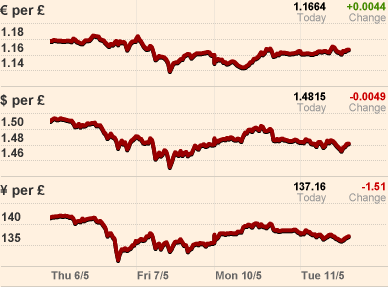 during a period when there is a real possibility of a Labour/Liberal pact.
 during a period when there is a real possibility of a Labour/Liberal pact.
20 April 2010
Mortgage Payment Protection Insurance
I have always been fascinated by the average consumers obsession with insurance. Its a massive industry. People buy insurance to cover all types of risk. Some insurance cover is a legal requirement, e.g. motor insurance. Other insurance is a contractual requirement e.g. buildings insurance when you have a mortgage.
Mortgage payment protection is another entirely. It seems to me that people would only take this out if they felt there employment was vulnerable. Secondly, from experience MPPI comes with so many exclusions many people find that their cover does not extend to the circumstances that have brought about their loss of employment. People excluded include the self-employed, people aware of a redundancy risk and people who work abroad.
Despite this MPPI remains popular and the market is increasingly competitive.
Mortgage payment protection is another entirely. It seems to me that people would only take this out if they felt there employment was vulnerable. Secondly, from experience MPPI comes with so many exclusions many people find that their cover does not extend to the circumstances that have brought about their loss of employment. People excluded include the self-employed, people aware of a redundancy risk and people who work abroad.
Despite this MPPI remains popular and the market is increasingly competitive.
Amex Card Problems Resolved
Things have improved with my American Express card. Back in March they offered me a refund. Despite this I still paid the late payment fee and monthly interest. The two charges were reversed in my April statement. I have also noticed a cashback rebate of £30. Things are looking up.
20 March 2010
Problems Closing American Express Account
I have just tried to close my American Express account. Apparently nobody at American Express' UK head quarters in Brighton is trained to close accounts. I tried to explain to the poor agent on the phone that she should get a supervisor but they're not trained to close accounts either. Or, when I asked, was their boss. And there are no escalation procedures in place to deal with the problem.
To me it seems another obvious ploy to stop people closing accounts.
To me it seems another obvious ploy to stop people closing accounts.
American Express Dispute

I've just got into a dispute with American Express. I was a day late making a payment of £403.75 against an American Express Platinum credit card. They've charged me £23.52. By my reckoning that's 5.83% for one day!!! On an annualised interest basis the charge is preposterous. Even if I ignore the £12 late payment fee, the interest fee is still £11.52, which works out at 2.85% for 1 day's delay.
This is the first time I've missed a payment with them. Needless to say I have told Amex I'm cancelling their card. Obviously American Express must factor in the sort of response I've made. Good luck to them. They won't get my custom ever again.
Subscribe to:
Posts (Atom)
