The HMRC allows 40p per mile for travel costs when using a car for business purposes. The rate of 40p per mile was set in 2002 when a litre of unleaded cost an average of 77.9p. Today the average cost of a litre is around £1.30, representing a rise of 68%. The rise in vehicle costs without a commensurate rise in travel allowances means the role of vehicle tracking systems becomes ever more crucial. Every additional and unnecessary mile driven adds unnecessary costs.
I use my own car for business trips. Tomorrow I am to make a business trip of around 264 miles. My mileage allowance will be £105.60. Back in 2002, at 33 miles per gallon my petrol costs would have been £28.29, leaving £77.31 to cover both the variable costs and a contribution towards the shared fixed costs of car ownersip. Tomorrow my petrol costs will be £47.22, leaving just £58.38 towards other costs. Even if all other costs had stayed the same since 2002, I am left with a 24.5% shortfall. I am probably, therefore subsidising my employer.
A quic estimate of the true costs of the trip - based on its share of my annual mileage - indicates a fairer mileage contribution would be nearer 65p per mile. I drive about 9,000 business miles per year and further 4,000 miles on private mileage. At current mileage rates and petrol costs it would appear that I am subsidising my business to the tune of £2,250 per annum. The daft thing is, if my business was to compensate me for these increased costs I would need to pay tax on them as a benefit. If the HMRC fails to raise mileage rates I foresee increase demands to bring back company vehicles.
23 February 2011


04 January 2011
VAT Rise - Retail Prices Up by 5 to 8%
UK VAT rose from 17.5% to 20% today. This means a whole range of goods and services will go up in price. The UK Government has introduced the tax rise in an attempt to raise £13 billion and close some of the £160 billion annual deficit it inherited from Labour.
The Daily Telegraph points out that many retailers will increase their prices by far more than the 2.1% net increase the tax rise should bring. It reports that many retailers will round up prices rather than round them down. It quotes examples of mobile phone tariffs going up by 10 and 20%. It also quotes the examples of Fitness first that has put up monthly subscriptions by 25% in some cases. I have personal experience of the Fitness First rise where a I received a letter informain me of 30%. I raised the matter with my local gym and have downgraded my membership in order to retain the old price.
The Daily Telegraph points out that many retailers will increase their prices by far more than the 2.1% net increase the tax rise should bring. It reports that many retailers will round up prices rather than round them down. It quotes examples of mobile phone tariffs going up by 10 and 20%. It also quotes the examples of Fitness first that has put up monthly subscriptions by 25% in some cases. I have personal experience of the Fitness First rise where a I received a letter informain me of 30%. I raised the matter with my local gym and have downgraded my membership in order to retain the old price.
10 December 2010
Sterling Strongest Currency Tip for 2011
Barcap, the securities trading arm of Barclays Bank, has tipped the UK currency to to be the world's strongest in 2011. The pound has fallen 20% since the Banking crisis began in September 2008. Specific forecast rates of $1.82 and euro 1.28 is given for the end of 2011. Sterling closed at $1.58 today. This implies a rise of 15% against the Dollar and 7% against the Euro. Barclays is also bullish about the UK stockmarket, forecasting a rise of 18% in the FTSE.
26 October 2010
Banks Should Be Broken Up - Mervyn King
Mervyn King, the Governer of the Bank of England, has advanced the argument that banks should be broken up. The message came in a speech made in New York. In a section of his speech that specifically referred to the relationship between investment banking and retail banking King said that the only way to guaranee the assets of depositors was to separate them from more risky assets.
Over recent years traditional high street banks have increasingly involved themselves in investment. Whilst short-term profits may be earned from speculative deals, the activity also exposes banks to risking their whole deposit base. Halifax Bank of Scotalnd and Royal Bank of Scotland were both on the verge of collapse due to their exposure to investment banking. Only the UK government's need to protect retail depositors saved the two major banks from collapse.
Over recent years traditional high street banks have increasingly involved themselves in investment. Whilst short-term profits may be earned from speculative deals, the activity also exposes banks to risking their whole deposit base. Halifax Bank of Scotalnd and Royal Bank of Scotland were both on the verge of collapse due to their exposure to investment banking. Only the UK government's need to protect retail depositors saved the two major banks from collapse.
25 October 2010
Payday loans for quick money – but pay back promptly!
Research by watchdog Consumer Focus says that 1.2 million people are taking payday loans every year collectively borrowing more that £1million. That is almost four times the number of people from four years ago. As the number of people struggling to make ends meet on a monthly basis is growing, payday loans are increasingly a short term solution for people finding it hard to secure finance. And surprisingly, this kind of borrowing may be a better solution than paying your bank or a credit card company for expensive unauthorised overdrafts. As long as you comply with one rule – pay back promptly at the next payday!
Loans on offer are typically from £50 - £1,000 depending on provider. They are available online, quick to apply for and you could have the money in your account within an hour. Charges for these types of loans range on average from £13 to £18 interest for every £100 borrowed. However, if the loans are rolled over, the debts will increase sharply as interest charges rise.
The most unscrupulous companies are charging interest rates of more than 2,500% a year. As a result, the watchdog is urging the industry to bring in more protection for vulnerable borrowers. Outlawing payday loans could leave some borrowers vulnerable to illegal loan sharks. Instead sensible safeguards would stop borrowers becoming dependent on this kind of high cost credit and prevent even more stringent controls being needed in the future.
Sarah Brooks, head of financial services at Consumer Focus, commented: “Payday loans are a valid form of credit and it’s much better for people to take one out rather than go to a loan shark. But we do think there needs to be a limit on the number of loans people take out and how many loans they are able to roll over,” she explained. Maybe banks could also develop a valuable service and benefits all around by providing an alternative short-term credit to suit the needs of cash-strapped consumers?
Click the post title to listen to a BBC radio interview of Sarah Brooks on the subject of payday loans.
21 October 2010
Has Osborne Cut Enough from Public Spending?
I have just read Jeff Randall's contribution to tomorrow's Daily Telegraph. After reading the article, that points out that Osborne's cuts in spending will only get public expenditure back to 2006-7 levels. And that is not until 2014.
What is shocking about the whole issue is the belief by much of the population - especially those outside of the south and midlands of England - that they are somehow entitled to take money whether they deserve it or not. On last night's TV I watched a woman from Swansea moan about the fact she had lost the child benefit of a daughter who had left school. Why she posited should she not carry on getting this benefit. Her rationale, and that of the TV narrator, appeared to be that she lived in Wales. And that because of the local economy, they were somehow entitled to money, whether earned it or not.
Even Jeremy Paxman joined in. Constantly complaining to Treasury Secretary Danny Alexander about the poorest 10% of the population, almost all of whom live entirely on benefit and have therefore enjoyed inflation-linked rises in tax free income over the past three years, whilst almost everyone in employment has seen their real incomes diminish in value.
Yes it's time to cut. But I do not believe Osborne has gone far enough in cutting the waste that is central to much of the public sector.
What is shocking about the whole issue is the belief by much of the population - especially those outside of the south and midlands of England - that they are somehow entitled to take money whether they deserve it or not. On last night's TV I watched a woman from Swansea moan about the fact she had lost the child benefit of a daughter who had left school. Why she posited should she not carry on getting this benefit. Her rationale, and that of the TV narrator, appeared to be that she lived in Wales. And that because of the local economy, they were somehow entitled to money, whether earned it or not.
Even Jeremy Paxman joined in. Constantly complaining to Treasury Secretary Danny Alexander about the poorest 10% of the population, almost all of whom live entirely on benefit and have therefore enjoyed inflation-linked rises in tax free income over the past three years, whilst almost everyone in employment has seen their real incomes diminish in value.
Yes it's time to cut. But I do not believe Osborne has gone far enough in cutting the waste that is central to much of the public sector.
01 October 2010
Bank of England Warns on Mortgage Tightening
The Bank of England has issued a warning regarding the tightening of mortgage lending by banks and building societies. Banks, it seems, are getter tougher on mortgage lending because they fear the consequences of higher unemployment. The Bank fears that this tightening of leanding will inevitably lead to a fall in house prices, with all the attendant problems this creates in the current recessionary environment.
Banks are apparently asking for higher deposits at the same time as lending at lower earnings multiples. They have also targeted people who borrow on an interest only basis. These people, more often than not, do not have an effective repayment vehicle in place. Therefore the balance outstanding remains constant.
House price data from The Nationwide Index, produced by Britain's largest building society indicates that house price rises are indeed slowing down. In the year to September the increase has fallen to 3.1%, giving an average UK house price of £166,757.
Banks are apparently asking for higher deposits at the same time as lending at lower earnings multiples. They have also targeted people who borrow on an interest only basis. These people, more often than not, do not have an effective repayment vehicle in place. Therefore the balance outstanding remains constant.
House price data from The Nationwide Index, produced by Britain's largest building society indicates that house price rises are indeed slowing down. In the year to September the increase has fallen to 3.1%, giving an average UK house price of £166,757.
09 September 2010
Don't Pay for HMRC Tax Errors
UK workers are being told by financial experts that they have a legal right to avoid HMRC tax repayment demands.
The HMRC has made a huge number of errors in calculating the tax owed in previous years. Up to 5.7 million PAYE (pay as you earn) taxpayers are affected. About 4.3 million people have paid too much tax and will expect a rebate in their pay packets. A further 1.4 million have paid too little. It is this latter group who can expect a demand.
Essentially under a tax loophole it seems that if people have provided the correct information and the HMRC have made the wrong calculations and taken too little tax, the tax payer can ask to have any underpaid tax set aside.
The HMRC has made a huge number of errors in calculating the tax owed in previous years. Up to 5.7 million PAYE (pay as you earn) taxpayers are affected. About 4.3 million people have paid too much tax and will expect a rebate in their pay packets. A further 1.4 million have paid too little. It is this latter group who can expect a demand.
Essentially under a tax loophole it seems that if people have provided the correct information and the HMRC have made the wrong calculations and taken too little tax, the tax payer can ask to have any underpaid tax set aside.
31 July 2010
UK Banks Skim £7 Billion from Savings
A report in today's Daily Telegraph claims that UK banks are skimming off an estimated total of £7 billion from consumer bank accounts.
The skimming is caused by a range of unecessary fees and hidden charges, making it very difficult for a UK investor to match stock market growth.
To read the full article, click on the post title above.
The skimming is caused by a range of unecessary fees and hidden charges, making it very difficult for a UK investor to match stock market growth.
To read the full article, click on the post title above.
26 July 2010
Payment Protection Market Takes a Turn
I have noticed an interesting turn in the payment protection market. This market includes search terms such as payment protection, income protection, mortgage payment protection and abbreviations such as MPPI (mortgage payment protection insurance) and PPI.
Until recently the paid search results were dominated by companies actually selling payment protection. Recently, however, I have noticed a growing market for people advertising their services over the issue of payment protection insurance. I assume that many of these advertisers are offering a reclaim service and will take a cut of any refunds secured. It seems the banks, mortgage companies, building societies and insurance companies over sold the benefits of payment protection to unsuspecting customers.
Payment protection is inherently high risk. People will only take out a policy if they feel they are at some form of enhanced risk, such as redundancy. Indeed, the demand for this type of policy has been growing as public sector workers feel they may well be victims of the new coalition government's spending cuts. If an employee believes he ot she is at risk of redundancy at the time of taking out the policy they must disclose the material facts. Or otherwise their policy is invalidated. Unfortunately, invalidation is often the case. So you can see why policy holders may well claim that they have been missold.
Until recently the paid search results were dominated by companies actually selling payment protection. Recently, however, I have noticed a growing market for people advertising their services over the issue of payment protection insurance. I assume that many of these advertisers are offering a reclaim service and will take a cut of any refunds secured. It seems the banks, mortgage companies, building societies and insurance companies over sold the benefits of payment protection to unsuspecting customers.
Payment protection is inherently high risk. People will only take out a policy if they feel they are at some form of enhanced risk, such as redundancy. Indeed, the demand for this type of policy has been growing as public sector workers feel they may well be victims of the new coalition government's spending cuts. If an employee believes he ot she is at risk of redundancy at the time of taking out the policy they must disclose the material facts. Or otherwise their policy is invalidated. Unfortunately, invalidation is often the case. So you can see why policy holders may well claim that they have been missold.
New Family Dental Insurance Website
 The I Want Dental Cover website is now live. The I Want website offers an online family dental insurance product.
Apart from lower prices for dental insurance, a key selling point is the speed and convenience of the Quick Quote process.
Dental cover options are availabe for both private dentist and NHS dentist services.
Most UK dental insurance is sold through dentists or major insurance operations such as Simply Health or Tesco. I Want Dental Cover is backed by insurance industry specialists with experience of direct to customer insurance products.
As an online only product, I Want aims to undercut competitors on price and deliver a more customer friendly service.
13 May 2010
The EU Cuts Spain's Public Sector Pay
The EU has stepped in and forced a 5% reduction in the pay of Spain's public sector employees. Spain has a UK-like public sector deficit of 11% of GDP. As a Eurozone member it is meant to adhere to a maximum deficit of 3% of GDP.
As well as pay, pensions and Spain's 2,500 Euro "Baby bonus" are also to be cut.
The EU has been forced to take the initiative given the fall out from the Greek financial debacle.
Will the Tory and Liberal Democratic dare impose such fiscal discipline on the UK economy?
As well as pay, pensions and Spain's 2,500 Euro "Baby bonus" are also to be cut.
The EU has been forced to take the initiative given the fall out from the Greek financial debacle.
Will the Tory and Liberal Democratic dare impose such fiscal discipline on the UK economy?
11 May 2010
Markets Incredibly Stable During Political Turmoil
I find it amazing how stable the Sterling exchange rate is versus the major gobal currencies of the US Dollar, Euro and Japanese Yen during this period of unprecedented political turmoil. If we take out the fluctuations due to the Greece crisis there has been very little downward movement in Sterling 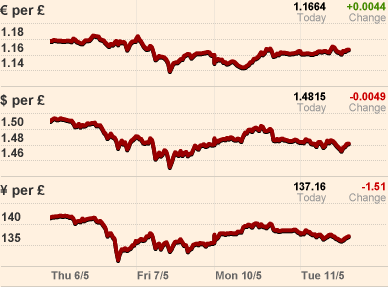 during a period when there is a real possibility of a Labour/Liberal pact.
 during a period when there is a real possibility of a Labour/Liberal pact.
20 April 2010
Mortgage Payment Protection Insurance
I have always been fascinated by the average consumers obsession with insurance. Its a massive industry. People buy insurance to cover all types of risk. Some insurance cover is a legal requirement, e.g. motor insurance. Other insurance is a contractual requirement e.g. buildings insurance when you have a mortgage.
Mortgage payment protection is another entirely. It seems to me that people would only take this out if they felt there employment was vulnerable. Secondly, from experience MPPI comes with so many exclusions many people find that their cover does not extend to the circumstances that have brought about their loss of employment. People excluded include the self-employed, people aware of a redundancy risk and people who work abroad.
Despite this MPPI remains popular and the market is increasingly competitive.
Mortgage payment protection is another entirely. It seems to me that people would only take this out if they felt there employment was vulnerable. Secondly, from experience MPPI comes with so many exclusions many people find that their cover does not extend to the circumstances that have brought about their loss of employment. People excluded include the self-employed, people aware of a redundancy risk and people who work abroad.
Despite this MPPI remains popular and the market is increasingly competitive.
Amex Card Problems Resolved
Things have improved with my American Express card. Back in March they offered me a refund. Despite this I still paid the late payment fee and monthly interest. The two charges were reversed in my April statement. I have also noticed a cashback rebate of £30. Things are looking up.
20 March 2010
Problems Closing American Express Account
I have just tried to close my American Express account. Apparently nobody at American Express' UK head quarters in Brighton is trained to close accounts. I tried to explain to the poor agent on the phone that she should get a supervisor but they're not trained to close accounts either. Or, when I asked, was their boss. And there are no escalation procedures in place to deal with the problem.
To me it seems another obvious ploy to stop people closing accounts.
To me it seems another obvious ploy to stop people closing accounts.
American Express Dispute

I've just got into a dispute with American Express. I was a day late making a payment of £403.75 against an American Express Platinum credit card. They've charged me £23.52. By my reckoning that's 5.83% for one day!!! On an annualised interest basis the charge is preposterous. Even if I ignore the £12 late payment fee, the interest fee is still £11.52, which works out at 2.85% for 1 day's delay.
This is the first time I've missed a payment with them. Needless to say I have told Amex I'm cancelling their card. Obviously American Express must factor in the sort of response I've made. Good luck to them. They won't get my custom ever again.
15 January 2010
Obama's New Tax Costs UK Banks £11 Billion
Barack Obama has announced a new $90 billion tax on the US banking industry that will have massive repercussions in the UK. UK banks will apparently be forced to pay £11 billion as their share of the cost of repaying US tax payers for their support of the TARP programme.
Mortgages - Fix Rate or Not?

I have a had a New Year present from Bank of Ireland Mortgages. My mortgage rate has fallen from a fixed rate 5.99% to a variable rate 2.99%.
My original fixed rate mortgage was taken out with Bristol and West back in 2002. Bristol and West charged me 4.39% for a 5 year fixed rated mortgage. This original mortgage expired in 2007 and was repaced by the new fixed rate of 5.99% for two years. Bristol and West has been acquired by Bank of Ireland and rebranded. Due to the wider financial problems of Ireland - the country - Bank of Ireland have withdrawn most of their attractive fixed rate deals.
The question I now face is whether to fix my mortgage rate again - at around 4.8% for 4 or 5 years with another mortgage provider - or to carry on taking the benefit of a lower variable rate mortgage.
14 January 2010
Getting a Dentist
Living in the fastest growing town in the UK has its problems. Government spending tends to be based on census data from 2001 when the population was much smaller.
Getting access to public services tends to present real problems as a smaller budget per person tends to be allocated than for other parts of the country. In addition, a growing population tends to have a higher proportion of children. And these tend to absorb disportionate amounts of heath and education spending. This problem is extremely evident when it comes to accessing a dentist. Children get priority and therefore ordinary adults have to go to the back of the queue.
NHS dental treatment is extremely scarce in the local area and many people are driven by necessity to private dental treatment. The interesting thing is the contrast between optician and dental services. Dental treatment gets more and more expensive and yet competition between opticians is driving down the prices of spectacles and sight testing.
Getting access to public services tends to present real problems as a smaller budget per person tends to be allocated than for other parts of the country. In addition, a growing population tends to have a higher proportion of children. And these tend to absorb disportionate amounts of heath and education spending. This problem is extremely evident when it comes to accessing a dentist. Children get priority and therefore ordinary adults have to go to the back of the queue.
NHS dental treatment is extremely scarce in the local area and many people are driven by necessity to private dental treatment. The interesting thing is the contrast between optician and dental services. Dental treatment gets more and more expensive and yet competition between opticians is driving down the prices of spectacles and sight testing.
06 December 2009
Darling to Target Tax Increases at High Earners
 UK Chancellor Alistair Darling appears ready to announce a whole range of tax increases targeted at higher earners.
According to the Telegraph Darling is expected to use the Pre-Budget Report to increase the rate of tax on company profits and levy additional taxes on the super rich such as bankers. These tax increases are on top of the increases announced last year that will come into effect in April 2010. Already in the pipeline are increases in national insurance plus a 50% tax rate for those earning more than £150,000 per annum.
Sadly for the socialists in charge of UK government finances, they do not seem to recognise that these sorts of taxes will just drive higher earners away. They are the sort of tactics tried by the Labour governments of the 1960s and 1970s. The public sector deficit is expected to top £175 billion in 2009/10 as tax revenues fall.
12 November 2009
Estate Agents Regularly Lie
A study by the Office of Fair Trading (The OFT) has found that estate regularly misdescribe the homes they are selling.
The report shows that 24% of estate agents are not complying with consumer protection laws. Despite this, it seems that consumers still prefer to deal with a high street estate agent rather than rely entirely on the Internet.
The Internet is perhaps no more impartial than the high street agent. However, at least you are not subject to a hard sell. Given my local interest in the Kent housing market, I have noticed a new blog has started up that covers new homes in Kent.
The Kent housing market is a thriving on the back of improved transport links. The most significant being the high speed rail service that connects Ashford, Canterbury and Folkestone to St. Pancras International station in London.
The report shows that 24% of estate agents are not complying with consumer protection laws. Despite this, it seems that consumers still prefer to deal with a high street estate agent rather than rely entirely on the Internet.
The Internet is perhaps no more impartial than the high street agent. However, at least you are not subject to a hard sell. Given my local interest in the Kent housing market, I have noticed a new blog has started up that covers new homes in Kent.
The Kent housing market is a thriving on the back of improved transport links. The most significant being the high speed rail service that connects Ashford, Canterbury and Folkestone to St. Pancras International station in London.
06 November 2009
House Price Rise of 4% in 2009
Savill's the upmarket estate agent is forecasting a year-end rise in house prices of 4% for 2009. This follows a fall of 8% in 2008.
The overall picture is very patchy, with the south generally outperforming the north. The bad news is that Savill's is forecasting a 6.6% fall in 2010. Why would anybody buy a house now if its going to be substantially cheaper in 12 months time?
One factor driving current demand is cheaper mortgages. With base rates still at 0.5% the mortgage lenders are making tidy margins. A rise in base rates is factored into most fixed rates. But there's still a wider margin than in previous years.
Living in Ashford, Kent the local housing market has been distorted by the arrival of the high speed train service to London. The market for new homes in Kent has been deflated for the past 18 months. So buyers are straining to access the housing stock. A neighbour recently put their house in the market for £75,000 more than they paid for it 2 years ago. It seems the house is now sold subject to contract. So maybe Ashford is performing better than other areas.
The overall picture is very patchy, with the south generally outperforming the north. The bad news is that Savill's is forecasting a 6.6% fall in 2010. Why would anybody buy a house now if its going to be substantially cheaper in 12 months time?
One factor driving current demand is cheaper mortgages. With base rates still at 0.5% the mortgage lenders are making tidy margins. A rise in base rates is factored into most fixed rates. But there's still a wider margin than in previous years.
Living in Ashford, Kent the local housing market has been distorted by the arrival of the high speed train service to London. The market for new homes in Kent has been deflated for the past 18 months. So buyers are straining to access the housing stock. A neighbour recently put their house in the market for £75,000 more than they paid for it 2 years ago. It seems the house is now sold subject to contract. So maybe Ashford is performing better than other areas.
16 October 2009
Nationwide Cuts Mortgage Rates

The Nationwide Building Society has cut mortgage rates by as much as 0.84% in a sign that competition is finally returning to the market for housing finance. The average cut across about 30 mortgage products of Britain's biggest building society is 0.23%. This is a welcome sign for those people who took out fixed mortgages 2 years ago when the LIBOR interest rate went above 6% following the near-collapse and Government take over of Northern Rock. At the time, bankers were unable to source funds on the wholesale markets.
The Nationwide's rate for a 4 year fixed mortgage will fall from 5.78% to 4.94%. Both HSBC and Abbey have recently tweaked their mortgage products. Various house price indices have indicated that the housing market is now past its bottom encouraging lenders to re-enter the market for 90 and 95% loan to value mortgages. The best deals remain for those borrowing less than 60% of their property's value.
15 October 2009
Halifax Credit Cards and Inertia Theft

Why are The Halifax so useless? I started dealing with them 8 years ago when I took out a Halifax credit card and I've regretted it ever since. Now that their parent company HBOS is largely owned by the tax payer I'm ever angrier with their incompetence.
I fell out with them about a year ago over a dispute with a supplier. Halifax told me that I would have to pay the sum involved. In order to prevent that happening I told them I would close the account. Halifax said I couldn't do that because there was a £9.90 balance that wasn't due for 3 weeks. I paid the balance immediately and asked for the account to be closed. I was referred to several people before that accepted my request. However, they never closed the account. At the end of the month, £9.90 was taken from my bank account. This left a positive balance. But I'd stopped using the card and, as far as I was concerned, had closed the account.
Six months later I received a letter saying that as I hadn't used the card for some time, my credit limit would immediately be reduced from £15,000 to £500, then closed 4 weeks later. As far as I was concerned the account was already closed!!!
Any how I phoned Halifax, told them the facts and asked for my money. The £9.90 balance outstanding. According to the person on the phone this couldn't be returned unless I put my request in writing. Which I duly did. Today I've received a letter - a standard one - from an Angela Taylor who styles herself Senior Manager, Customer Services, that explains all manner of restrictions relating to future charges but no mention of the money they owe me. Given the effort I've put in to get my money I can only put this down to a deliberate policy of inertia theft. Its only a small sum. But the Halifax are driving me mad.
Interestingly, my business holds a current account with Bank of Scotland. I am so p****d of with them I'll be transferring that to another bank. Preferably one that isn't in hock to the tax payer.
12 October 2009
Why the 50% Tax Rate Should Be Abolished
Philip Johnston of The Daily Telegraph uses an extremely amusing example of why the proposed 50p rate of income tax should be abolished. The example uses pints of beer. Where the drinkers are charged according to how much they earn. The poorest pay nothing and the rich pay the most. Everything goes well until a tax cut means the richest drinker gets the biggest rebate. The other drinkers take exception and in response attack the richest drinker. He promptly leaves the drinking circle, forcing up the price of beer for everyone else.
The moral of the story is that it doesn't take many rich people to drop out of the tax system before everyone else ends up paying more. Interestingly, in the real world, Britain has done a good job attracting tax payers from all levels. It is the richest ones who are the most mobile - take top class footballers and celebrities as recent and newsworthy examples. Just a few of these tax payers may well end up leaving in the short term. But in the long run not only will large numbers leave but fewer of the highest earners will come to Britain in the first place.
For the full story click on the post title.
The moral of the story is that it doesn't take many rich people to drop out of the tax system before everyone else ends up paying more. Interestingly, in the real world, Britain has done a good job attracting tax payers from all levels. It is the richest ones who are the most mobile - take top class footballers and celebrities as recent and newsworthy examples. Just a few of these tax payers may well end up leaving in the short term. But in the long run not only will large numbers leave but fewer of the highest earners will come to Britain in the first place.
For the full story click on the post title.
24 September 2009
Is Car Advertising Deliberately Dodgy - Seat Ibiza?

I am increasingly frustrated with car advertising. That's whether I'm intending to buy or lease. My latest frustrating experience concerns a SEAT Ibiza Sports Coupe. This was advertised at a lease price of £138 plus VAT per month.
When I contacted the company, the colour I wanted was an extra £12 per month. £12 per month equates to 8.7% of the original price. So after considerating that the colour didn't matter that much I asked the salesman for any colour that could be supplied at the £138 price being advertised. Sadly, the salesman was unable to locate any car for that price. Meanwhile, as I make this posting, the car is still being advertised at £138 per month on both the company's website and through Google Adwords. The website even has a labe of "in stock" next to price. Apparently, as I've found out, no stock exists at the price quoted.
23 September 2009
Liberals Mansion Tax Blunder
The Liberal Democrats have blundered their way to election disaster with the announcement of a "mansion tax" on houses worth more than £1 million. Poor old Vince Cable, once seen as a voice of economic sanity, is now the target of a sustained assault by the middle class media.
Vince thought he had a vote winner. Tax the rich and make them pay for the tax cuts of the poor was his spin on the announcement. This has gone horribly wrong as many of the Lib-Dem marginal seats are in the south east, where £1 million houses are not so rare.
According to Vince just 1% of housing stock, approximately 200,000 properties come into the million plus class. He argued for a 0.5% tax on the value of these, raising £5,000 per household. However, voters remember the poll tax and the difficulties of collecting that. A mansion tax will be a nightmare. Simply, if you own a £1.2 million house, split it into two and have two £600,000 houses. In addition, the sorts of people who own £1 million plus houses are also good at organising their affairs in order to minimise their tax liabilities. Imagine the battles between town halls and their wealthier residents.
Lastly, Vince's approach attacks people's aspirations. I don't own a £1 million house - yet. But I would certainly like one. If I work hard enough, having paid tax on the money I use to buy one, why should I then pay another £5,000 a year to live in it?
See also: Vince Cable's Dangerous Thinking.
Vince thought he had a vote winner. Tax the rich and make them pay for the tax cuts of the poor was his spin on the announcement. This has gone horribly wrong as many of the Lib-Dem marginal seats are in the south east, where £1 million houses are not so rare.
According to Vince just 1% of housing stock, approximately 200,000 properties come into the million plus class. He argued for a 0.5% tax on the value of these, raising £5,000 per household. However, voters remember the poll tax and the difficulties of collecting that. A mansion tax will be a nightmare. Simply, if you own a £1.2 million house, split it into two and have two £600,000 houses. In addition, the sorts of people who own £1 million plus houses are also good at organising their affairs in order to minimise their tax liabilities. Imagine the battles between town halls and their wealthier residents.
Lastly, Vince's approach attacks people's aspirations. I don't own a £1 million house - yet. But I would certainly like one. If I work hard enough, having paid tax on the money I use to buy one, why should I then pay another £5,000 a year to live in it?
See also: Vince Cable's Dangerous Thinking.
14 September 2009
House Price Rise is a False Dawn
The Ernst and Young ITEM club have produced an economic report that claims that the current bouyancy in the UK housing market is a false dawn. The club forecasts that prices will soon start to fall again and that they wont return to the peak price levels of 2007 until 2014.
Recent price rises, seen since the spring, have been driven by a shortage of properties. At some point the immediate shortage will be over and the underlying recessionary conditions will put a dampener on the ability of buyers to raise bids.
At current mortgage interest rates, home buying is currently more affordable than at any time in the previous 7 years. HSBC recently a 1.99% mortgage product for those buyers who can afford a 40% deposit.
Recent price rises, seen since the spring, have been driven by a shortage of properties. At some point the immediate shortage will be over and the underlying recessionary conditions will put a dampener on the ability of buyers to raise bids.
At current mortgage interest rates, home buying is currently more affordable than at any time in the previous 7 years. HSBC recently a 1.99% mortgage product for those buyers who can afford a 40% deposit.
30 June 2009
UK Economy Shrinking Faster Than Previously Thought
The Office of National Statistics (ONS) has revealed that the UK economy is shrinking faster than earlier figures. The growth figure for the 1st Quarter of 2009 has been downgraded to -2.4% from the previous -1.9%. Not only is the economy shrinking faster but the ONS has revised 2008 GDP figures to show that the economy started shrinking earlier than previous indications. This means that the UK recession began in Quarter 2, 2008 rather than Quarter 3.
The good news for Chancellor Alistair Darling is that with such poor figures for early 2009, it may well be possible to show that the economy is growing by the time Labour calls the 2010 General Election.
The good news for Chancellor Alistair Darling is that with such poor figures for early 2009, it may well be possible to show that the economy is growing by the time Labour calls the 2010 General Election.
12 March 2009
HMRC Wrongly Fines Taxpayers
Britain's tax office, the HMRC, have wrongly fined 20,000 taxpayers for late submission of their 2007-8 tax returns.
UK taxpayers are fined £100 for failing to submit their returns by midnight on 31st January. Due to complaints from professional accountants the HMRC have admitted they have made mistakes. Indeed I am one of the victims. The problem I suspect is that the HMRC's computer systems cannot cope with requirement for taxpayers to make their submission online.
In my own case I tried to submit my return on the evening of 3oth January only to find the system rejected the password the HMRC had supplied me with. The following day an HMRC helpdesk operative got me to try using various browsers and computers without success. As a result of the systems failure I was given an extension. It took more than a week - until 12th February - before the HMRC could confirm that my return had been received.
Shockingly, 3 weeks later I received a letter informing me of my fine for late submission. The HMRC letter was dated 2 weeks prior to my receipt of it. I wrote back next day but have today (12th March 2009) received another letter (dated 5th March 2009) charging me with interest.
My only hope is that the revelation that thousands of taxpayers have been wrongly fined will lead to some form of amnesty.
UK taxpayers are fined £100 for failing to submit their returns by midnight on 31st January. Due to complaints from professional accountants the HMRC have admitted they have made mistakes. Indeed I am one of the victims. The problem I suspect is that the HMRC's computer systems cannot cope with requirement for taxpayers to make their submission online.
In my own case I tried to submit my return on the evening of 3oth January only to find the system rejected the password the HMRC had supplied me with. The following day an HMRC helpdesk operative got me to try using various browsers and computers without success. As a result of the systems failure I was given an extension. It took more than a week - until 12th February - before the HMRC could confirm that my return had been received.
Shockingly, 3 weeks later I received a letter informing me of my fine for late submission. The HMRC letter was dated 2 weeks prior to my receipt of it. I wrote back next day but have today (12th March 2009) received another letter (dated 5th March 2009) charging me with interest.
My only hope is that the revelation that thousands of taxpayers have been wrongly fined will lead to some form of amnesty.
05 March 2009
Marks and Spencer Still Cutting VAT

There's been some debate about the value of the temporary reduction in VAT. Recent reports in the newspapers have even pointed out that some retailers have quietly managed to forget it and have moved prices back to their pre-December levels.
One retailer, however, is still keeping honest. Marks and Spencer. Today, I was cutting through my local branch on the way to the Post Office when I noticed that polo shirts were back in stock. These were labelled at £5 each. I couldn't resist buying one. At the till I presented my £5, only to be given 11p in change. This is just a tad more than the 2.13% reduction the VAT change should have made. Good old Marks and Spencer.
Bank of England Cuts Interest Rates to 0.5%
The Bank of England today cut its minimum lending rate to 0.5%. Another record low, since its foundation in the 17th Century. Given that in that time we've had two Jacobite rebellions, fought two World Wars, seen off Napoleon and built and lost a global empire, the record low interest rate gives a measure of the current crisis. So much for Gordon Brown's claimed ending of the business cycle.
At the same time, the Bank will also pour £75 billion worth of extra currency into the nation's monetary supply. This represents 5.4% of GDP. Poor old Milton Friedman and Sir Alan Walters must be turning in their graves.
The implication for the financial services markets has yet to be assessed. You can still get 3 or 4% on your savings. And very few people are benefiting from super low mortgage rates. Interestingly at this precise time the FTSE is showing a fall of 3.0% against last night's close.
At the same time, the Bank will also pour £75 billion worth of extra currency into the nation's monetary supply. This represents 5.4% of GDP. Poor old Milton Friedman and Sir Alan Walters must be turning in their graves.
The implication for the financial services markets has yet to be assessed. You can still get 3 or 4% on your savings. And very few people are benefiting from super low mortgage rates. Interestingly at this precise time the FTSE is showing a fall of 3.0% against last night's close.
01 March 2009
Sir Fred Has Little Prospect of Enjoying His Millions

Poor Sir Fred Goodwin. Sitting smugly up in Scotland contemplating the largesse of English tax payers. Sir Fred has got it all wrong. If he had any sense he would immediately return the £23 million he filched from the tax payer as part of his compromise deal for the greatest financial failure in corporate history. He is finished. He has as much chance of enjoying his retirement as Al Capone. For the rest of his life Fred will be as welcome as a leper. Al Capone made it to 48. Fred is already 50. The UK citizenry have paid him 40p each. They will want their pound of flesh. As the most despised person within the UK he has money but no personal credibility. Don't be surprised if Fred succumbs.
28 February 2009
Bankers Pension Row Rumbles On
Six months after being told that the politicians were going to crack down on greedy bankers, the public realise that these same politicians stood by as the bankers helped themselves to more money.
We are gradually finding out that even in failure these superstars of the banking crash were being handed million of £s at the very time the politicians were claiming to be cracking down on city salaries and bonuses. Fred Goodwin of RBS wasn't alone in being heaped with largesse. Fred's £8 million - up to £16 million according to some analysts - pension uplift may be the biggest pension top-up. But out there several more high profile bankers were rewarded with multi-million £ pension pot contributions just to give up their jobs. Jobs that had been done so well that their organisations were driven to record levels of bankruptcy.
The latest character to come to public attention is Peter Cummings. He was head of corporate lending at HBOS. Seems poor Mr. Cummings has to get buy on a pension pot £5.9 million. Now according to reports, much of this pension pot was agreed as a condition of his departure. Who were the idiots that dreamt up such huge rewards for such atrocious performance? Seems the politicians and their civil servants were blinded by the city slickers.
We are gradually finding out that even in failure these superstars of the banking crash were being handed million of £s at the very time the politicians were claiming to be cracking down on city salaries and bonuses. Fred Goodwin of RBS wasn't alone in being heaped with largesse. Fred's £8 million - up to £16 million according to some analysts - pension uplift may be the biggest pension top-up. But out there several more high profile bankers were rewarded with multi-million £ pension pot contributions just to give up their jobs. Jobs that had been done so well that their organisations were driven to record levels of bankruptcy.
The latest character to come to public attention is Peter Cummings. He was head of corporate lending at HBOS. Seems poor Mr. Cummings has to get buy on a pension pot £5.9 million. Now according to reports, much of this pension pot was agreed as a condition of his departure. Who were the idiots that dreamt up such huge rewards for such atrocious performance? Seems the politicians and their civil servants were blinded by the city slickers.
27 February 2009
Kent's Hidden Value as House Prices Slide

The Land Registry has published data that confirms that the value of UK housing continues to slide. Land Registry data is based on actual completed transactions and so measures prices slightly behind the Nationwide House Price index, which is based on mortgage approvals. In addition, The Nationwide represents just a sample of UK housing, whilst The Land Registry is a census. Lastly, the Nationwide report used data collected up until the middle of February, whilst the Land Registry's cut-off is 31st January.
Anyhow, according the the report UK house prices fell 15.1% over 12 months, with the average house transaction being £153,753.
At a more current level, I am definitely seeing more "sold" boards in my locality, Kent. Indeed some of these houses have been well above the average as my local postcode has an average transaction value of £450,000. Maybe Kent, and Ashford in particular, is a special case. Compared to the home counties at large, Kent has always represented value for money. Indeed on the basis of drive time and commuting distance from central London, Kent housing represents real value for money.
The environment for Kent house builders is also looking quite positive given the development of its transport links. Last week Ashford International Station saw the reintroduction of its Eurostar Brussels service and an increase in services to Paris. Secondly, and perhaps more importantly, South Eastern Trains have announced the early introduction of the high speed rail service to London St. Pancras. The 36.5 minute service (yes 36.5 minutes) will reduce fstest peak time journey times by 30 minutes. Powered by Japanes Hitachi trains and running on a dedicated high speed line, the new service will mean Ashford is as accessible to the capital as most towns on the M25 belt, whilst it is situated in the lowest densely populated area of the south east. This will make Ashford and the stations connecting to it a magnet for London's highy paid commuters. Prices for homes in the area can only go up - despite the general malaise elsewhere.
26 February 2009
House Prices Fall 17.6%
According to the Nationwide House Price Index, UK house prices have fallen by 17.6% in the 12 months to February. The fall during the month amounted to 1.8%. According to the building society average house is now worth £147,746. This is a fall of £31,612 against a year previously.
The Nationwide data conflicts with some of the anecdote emerging from the housing industry, that there has been an upturn in buyer interest. Much of the data suggests that the market has bottomed out and that for buyers with sufficient funds the market represents great value.
The market for housing market is currently hamstrung by the need to raise a much larger deposit than has traditionally been the case. First time buyers have typically entered the market with a deposit of 5 or 10%. However, finance providers have been reluctant to lend on this basis given the risks presented by negative equity.
A more positive sign is that the UK government-owned Northern Rock is back in the lending market. Prior to its demise as an independent business, Northern Rock was famous for its 125% mortgages. This time round, Northern Rock will require a 10% deposit.
The Nationwide data conflicts with some of the anecdote emerging from the housing industry, that there has been an upturn in buyer interest. Much of the data suggests that the market has bottomed out and that for buyers with sufficient funds the market represents great value.
The market for housing market is currently hamstrung by the need to raise a much larger deposit than has traditionally been the case. First time buyers have typically entered the market with a deposit of 5 or 10%. However, finance providers have been reluctant to lend on this basis given the risks presented by negative equity.
A more positive sign is that the UK government-owned Northern Rock is back in the lending market. Prior to its demise as an independent business, Northern Rock was famous for its 125% mortgages. This time round, Northern Rock will require a 10% deposit.
25 February 2009
Irish Police Raid Anglo-Irish Bank

The Irish police yesterday raided the offices of Anglo-Irish Bank. The bank is at the centre of a loans for shares scandal that has rocked the Irish financial establishment.
For the past 15 years Anglo-Irish was the glamour stock amongst the Irish financial sector. The problems at the bank have come on top of the general banking crisis. Ireland, relative to its population, has one of the largest banking sectors in Europe. Parallels have been drawn with Iceland. The problem and have seen the Irish stock market plummet to levels last seen 14 years ago.
02 February 2009
Government Spending on IT Soars
The incompetence of the UK public sector knows no bounds. As the weather forces the UK public sector to close down - whilst the private sector struggles on - The Times reports that the current overspend on government IT projects amounts to more than £18 billion.
Many IT projects - such as the NHS CRM system - are years behind schedule and are so mired in problems that there is little prospect that they will ever be completed. The NHS project is 4 years behind. Another project to manage the dsicredited tax credit system for the HMRC was orginally budgeted at £2.9 billion. Current estimates are that this will now cost £8.5 billion.
Only in the overpaid, over-pensioned, underworked, poorly managed, bloated public sector would such incompetence be allowed to continue. So much for the famous Prince2 project management system.
Many IT projects - such as the NHS CRM system - are years behind schedule and are so mired in problems that there is little prospect that they will ever be completed. The NHS project is 4 years behind. Another project to manage the dsicredited tax credit system for the HMRC was orginally budgeted at £2.9 billion. Current estimates are that this will now cost £8.5 billion.
Only in the overpaid, over-pensioned, underworked, poorly managed, bloated public sector would such incompetence be allowed to continue. So much for the famous Prince2 project management system.
29 January 2009
UK House Prices Fall 16.6%

A report in today's Telegraph indicates that the UK's housing slump continues. According to the Nationwide house index average prices fell 1.3% in January, giving a 12 month decline of 16.6%.
The news comes a day after the International Monetary Fund (IMF) reported that the UK's recession will be worse than for any other major economy. The logic is simple. The financial services sector is a bigger proportion of UK GDP than for any other major economy. Secondly, we have had one of the biggest housing price booms. Therefore, more of our people will be thrown out of work and more of us have personal wealth tied up in the housing sector. The decline in financial wellbeing tends to lead to a downward spiral; as people feel less well-off, they spend less money, leading to less economic activity.
The Nationwide report wasn't all doom and gloom. It refers to the level of economic stimulus provided by various government initiatives. Indeed some house builders report an increased level of buyer interest compared to the latter part of 2008.
27 November 2008
HMRC Rips Off Small Businesses with VAT Change
Today, I received my formal notification of the change in VAT rates. The Brown led Labour Government have made huge a song and dance about the so-called 2.5% cut in the standard rate from 17.5% to 15%. I call it so-called because even goods sold at the standard rate of VAT will only see a 2.13% reduction in their retail selling prices.
As a small business I am a member of the Flat Rate scheme. This means rather than have a complicated system of working out the deductions relating to input VAT I merely pay a flat rate to HMRC. The Flat Rate Scheme is available to most businesses turning over less than £187,500 (including VAT). It is a scheme that the UK Government is obliged promote under a directive from the EU.
I was surprised to find that on checking the new "detailed guide" that the flat rate for my trade sector had fallen from 9.5% to 8.5%. After all, the standard rate had fallen 1/7th, that is 14.3%. Why should the flat rate for my sector fall by just 10.5%?
I investigated further. The average flat rate across 55 trade sectors is 8.9% until 30th November and falls to 8.1% on 1st December. A fall of just 9.0%. Some sectors - including pubs - haven't changed at all. Despite collecting less VAT at the point of sale, these businesses will be expected to pay the same amount of VAT as before. This is a shocking state of affairs, that means the small business sector is actually paying for Gordon Brown's much heralded fiscal stimulus.
As a small business I am a member of the Flat Rate scheme. This means rather than have a complicated system of working out the deductions relating to input VAT I merely pay a flat rate to HMRC. The Flat Rate Scheme is available to most businesses turning over less than £187,500 (including VAT). It is a scheme that the UK Government is obliged promote under a directive from the EU.
I was surprised to find that on checking the new "detailed guide" that the flat rate for my trade sector had fallen from 9.5% to 8.5%. After all, the standard rate had fallen 1/7th, that is 14.3%. Why should the flat rate for my sector fall by just 10.5%?
I investigated further. The average flat rate across 55 trade sectors is 8.9% until 30th November and falls to 8.1% on 1st December. A fall of just 9.0%. Some sectors - including pubs - haven't changed at all. Despite collecting less VAT at the point of sale, these businesses will be expected to pay the same amount of VAT as before. This is a shocking state of affairs, that means the small business sector is actually paying for Gordon Brown's much heralded fiscal stimulus.
Gold Price Prediction Puts Spotlight on Brown
A leading gold bullion trader predicts that gold could rise to $2,000 per ounce by the end of next year. Tom Fitzpatrick who is the chief technical strategist for Citigroup says the wave of liquidity being poured into the global economy will see a flight to gold. The current price is $812 per ounce. UK Prime Minister Gordon Brown is famous for selling half of the UK's gold reserves between 1998-2000 at the bottom of the market. The Treasury secured an average price of $275 per ounce. So much for our leader's financial expertise.
25 November 2008
The Great Labour Rip-Off
Welcome to the land of the Great Labour Rip-Off. Yes, we're finally getting the socialist tax regime we deserve. After 11 years of pretending they were business and entrepreneur friendly we are now getting the traditional Labour tax treatment.
For those who haven't fully digested yesterday's news, presented by Alistair Darling as an answer to the recession, many sections of the population are heading for a 60% plus rate of marginal tax.
Changes to National Insurance (NIC), tax thresholds and the imposition of 45% top rate of tax, will mean people at both ends of the income spectrum will have see less than 40p from each additional £ they earn. This is Scandinavian levels of taxation without the Scandinavian level of public services. I know, I used to live there.
During the early 1990s I was a higher earner living in Denmark, which had a top tax rate of 62%. Interestingly, this top rate included local income which was effectively the rates - now council tax. On top of this all my mortgage interest (and any other loan interest) was tax deductible. Secondly as a family, we claimed £120 per month per child in family allowance. When all the calculations were made my effective taxation rate was less than 30% of total income - and I was earning £65k a year in 1992, equivalent to say £150k now.
When everything was weighed up I was paying about the same net level of tax as I would have done under the then UK regime of John Major. But living in Denmark meant a World Class health system, clean streets and low crime. Soon, in Gordon Brown's socialist dystopia, you will have marginal tax rates of over 60%, with council tax, water rates, prescription charges, parking charges at your local hospital combined with third world levels of public services. How have we got here?
For those who haven't fully digested yesterday's news, presented by Alistair Darling as an answer to the recession, many sections of the population are heading for a 60% plus rate of marginal tax.
Changes to National Insurance (NIC), tax thresholds and the imposition of 45% top rate of tax, will mean people at both ends of the income spectrum will have see less than 40p from each additional £ they earn. This is Scandinavian levels of taxation without the Scandinavian level of public services. I know, I used to live there.
During the early 1990s I was a higher earner living in Denmark, which had a top tax rate of 62%. Interestingly, this top rate included local income which was effectively the rates - now council tax. On top of this all my mortgage interest (and any other loan interest) was tax deductible. Secondly as a family, we claimed £120 per month per child in family allowance. When all the calculations were made my effective taxation rate was less than 30% of total income - and I was earning £65k a year in 1992, equivalent to say £150k now.
When everything was weighed up I was paying about the same net level of tax as I would have done under the then UK regime of John Major. But living in Denmark meant a World Class health system, clean streets and low crime. Soon, in Gordon Brown's socialist dystopia, you will have marginal tax rates of over 60%, with council tax, water rates, prescription charges, parking charges at your local hospital combined with third world levels of public services. How have we got here?
24 November 2008
Proposed VAT Cut - Not 2.5%
The widely reported speculation that VAT is to be cut from 17.5% to 15% and wil ead to a 2.5% reduction in retail prices requires some adjustment. Contrary to many reports, that the VAT cut will save £2.50 for every £100 spent, the actual figure will be nearer £2.13.
The maths is as follows:
Retail price of £100. To get the pre-VAT price divide £100 by 1.175. Net price = £85.11 (£85.1064 rounded). To get the new VAT inclusive price with 15% VAT, multiply this figure by 1.15. Equals £97.87 (£97.87234 rounded). Divide this into £100 and you get a reduction of 2.13% (2.1278 rounded).
The maths is as follows:
Retail price of £100. To get the pre-VAT price divide £100 by 1.175. Net price = £85.11 (£85.1064 rounded). To get the new VAT inclusive price with 15% VAT, multiply this figure by 1.15. Equals £97.87 (£97.87234 rounded). Divide this into £100 and you get a reduction of 2.13% (2.1278 rounded).
22 November 2008
Government to Lower VAT
According to a report posted this evening on the Telegraph.co.uk website, the Chancellor of the Exchequer Alistair Darling is about to announce a temporary cut in the rate of VAT (Value Added Tax). The reduction would be from 17.5% to 15%. This would be the minimum rate allowed by the EU.
The reduction is estimated to cost £12.5 billion. Essentially, the reduction is the reverse of Margaret Thatcher's approach. Thatcher preferred indirect taxes (taxes on spending) rather than direct taxes (taxes on incomes). The Labour logic is that if you cut taxes on incomes people may just save more. If you cut taxes on spending you encourage them to spend more.
Now that the tax reduction story is in the public domain, the government must move quickly. As Darling found with rumours of reductions on stamp duty, any anticipation of a tax cut will encourage consumers to defer purchases. My guess, base on my knowledge as an unpaid collector of VAT, is that the new rate will come into effect on 1st December. VAT is an extremely complicated tax to administer at the best of times and the change will create unproductive extra work for several hundred thousand small businesses and retailers. By 1st December my own business will be two thirds of the way through my VAT quarter. Meaning that some of my VAT will be charged at the old rate and some at the newer. I suspect I will be required to make two separate VAT returns for the quarter.
The reduction is estimated to cost £12.5 billion. Essentially, the reduction is the reverse of Margaret Thatcher's approach. Thatcher preferred indirect taxes (taxes on spending) rather than direct taxes (taxes on incomes). The Labour logic is that if you cut taxes on incomes people may just save more. If you cut taxes on spending you encourage them to spend more.
Now that the tax reduction story is in the public domain, the government must move quickly. As Darling found with rumours of reductions on stamp duty, any anticipation of a tax cut will encourage consumers to defer purchases. My guess, base on my knowledge as an unpaid collector of VAT, is that the new rate will come into effect on 1st December. VAT is an extremely complicated tax to administer at the best of times and the change will create unproductive extra work for several hundred thousand small businesses and retailers. By 1st December my own business will be two thirds of the way through my VAT quarter. Meaning that some of my VAT will be charged at the old rate and some at the newer. I suspect I will be required to make two separate VAT returns for the quarter.
06 November 2008
House Prices Back to 2005 Levels
On the day that the BoE cut base rates to 3%, Britain's biggest home loan provider, The Halifax, reports that house prices fell 15% in the year to October. House prices are now back to the same level as 2005. Wiping out 4 years of gains.
Bank Slashes Rates - Now 3%
The Bank of England Monetary Policy Committee (MPC) today slashed the minimum lending rate to 3%. This is the lowest since 1955 and the first time a cut of more than 0.5% has been implemented since Gordon Brown gave it independence in 1997.
Business leaders welcomed the move. An act of desperation to stave of the worst effects of recession. However, the major lenders appeared unlikely to pass on much of the 1.5% reduction.
Meanwhile, despite the business community welcoming the news, the FTSE fell 5.7%.
The reduction in rates is seen as an overt signal that inflation is no longer a threat.
Business leaders welcomed the move. An act of desperation to stave of the worst effects of recession. However, the major lenders appeared unlikely to pass on much of the 1.5% reduction.
Meanwhile, despite the business community welcoming the news, the FTSE fell 5.7%.
The reduction in rates is seen as an overt signal that inflation is no longer a threat.
28 October 2008
Dow Jones Climbs 10.9%

Could this be the end of the beginning? After weeks of really bad news the Dow Jones Industrial Average shrugged off data regarding poor consumer confidence to record a 10.88% rise to 9065. The prospect of a 0.5% cut in US interest rates appears to have over ridden the negative sentiment. It will be interesting to see how Asian and European stock markets reacts during the early part of Wednesday.
French Economy Overtakes UK
One consequence of the £ falling against the Euro and Dollar is that we are falling down the world rankings for the size of our economy. For so long we've heard that the UK is the world's fourth largest economy. No longer. On a trade weighted index the £ is now the weakest it's been seen 1996 - the year before Labour came to power. As a result the UK has been overtaken by China and France. With a quarterly GDP of $559 billion we are 7.8% behind France who are fifth and 13% of Italy who are seventh.
17 October 2008
French Holiday Homes in Sales Slump
According to the Daily Telegraph the sales of French holiday homes have slumped. The fall in sales is particularly sharp in traditional British havens such as the Dordogne. The problem is caused by a logjam in the British housing market. French rural properties are generally bought by more affluent British consumers - sometimes in the runup to retirement. With the British property market in freefall, prices are down 12-13% on 2007, potential buyers of French property are unable to raise the necessary cash.
10 October 2008
Petrol Prices on the Way Down

We may be nearing financial Armageddon but there is some good news out there. It seems the collapse in the global economy is driving down the price of oil. Brent Crude is now below $80 per barrel. Despite the £ sterling weakening against the US $ this has led to falls in prices at the pump. Tesco have announced a cut of 3p per litre to £1.06. By my reckoning that's still just over £4.80 per imperial gallon. But it seems Tesco are using market forces to bring down prices. Maybe we should put Tesco boss Terry Leahy in charge of running the economy?
The Truth About Iceland

As the FTSE spirals below 4,000, the UK Government intends to use legal action to pursue an estimated £19 billion worth of British cash tied up in Iceland. This is made up of £1 billion owed to UK local government, £6 billion owed to UK individuals and £12 billion owed to UK companies and institutions. The strangest thing is, what were these people and organisations doing relying so heavily on a tiny country?
Iceland has a population of 320,000. The UK's £19 billion represents and investment of almost £60,000 a head. Kent County Council, which represents a population of 1.4 million has £50 million at stake. The truth is emerging that, contrary to earlier reports, ratings agencies were flashing up warnings about Iceland as early as April. However, I would go further. The apparent financial success of Iceland and Icelandic companies - especially their banks - always smelt a little fishy.
Over recent years Icelandic banks such as Kaupthing, Glitnir and Landsbanki have been offering very attractive rates of interest. Generally much better than their UK domiciled equivalents. How could they do this on a long term basis? What intrinsic competitive advantage did they hold over traditional banks. Second, Icelandic investment companies such as Baugur were buying up huge chunks of the British high street with investments in companies such as Iceland (the grocery retailer), Karen Millen, House of Fraser and Hamleys. None of these companies was known to trading any better than their equivalents. But Baugur was awash with cash. Even West Ham United, a generally under-performing English Premiership football club, has been acquired by Icelandic owners. Who just happens to be connected to Landsbanki.
There's a generally in life, and one especially apt for finance, that if something sounds too good to be true it probably is. The rise of Iceland as an economic power house was too good to be true. The UK people, businesses and local government authorities that have lost money should have used common sense rather than waiting to be told by the ratings agencies that there was something rotten in Iceland.
09 October 2008
UK Councils Risk Money in Icelandic Banks
The latest twist in the banking crisis is that UK local government has hundreds of millions of pounds at risk. This is money on deposit with a number of Iceland's banks. As it stands, these deposits are not being guaranteed by the UK Treasury. The Treasury has undertaken to guarantee private deposits and plans to sue the Icelandic government for losses. According to a report in today's Daily Telegraph:
Based on information from Conservative councillors, the Tories said they had identified at least £160 million of council funds exposed in Landsbanki or Heritable.
One authority alone - Kent County Council - has £50 million deposited in Landsbanki and Heritable, as well as Glitnir Bank.
I am located in Kent and a Kent council tax payer. If the money is never recovered each Kent council tax payer stands to lose £100 each!
04 October 2008
Pipex - Rubbish Telecoms Provider


Pipex are a rubbish company. They are owned by those jokers of the telecoms market Tiscali. Yesterday I received a letter telling me my phone would be cut off as my account was apparently in arrears. When I tried to use my phone I was given a message telling me my service was suspended and that I should phone customer services on 150. Guess what? Number 150 was engaged and remained so all day.
I got through to Pipex via an 0800 number. The staff at the end of the line told me that as an ex-Bulldog customer I needed to speak to Pipex Homecall - a separate division. I spoke to Pipex home call who told me they couldn't help as I was a business customer and needed to speak to the Pipex business team. So I phoned back the business team. I was asked, "Are you an ex-Bulldog customer?". On answering "Yes", the phone was put down. I originally signed up with Bulldog. At the time they operated UK call centres, based in Manchester. Now they have been acquired by Tiscali they have gone down the pan.
Several frustrating phone calls later I was told by Pipex's Lithuanian call centre, that they had a problem and that I shouldn't be cut off. However, this person couldn't rectify the matter, neither could their boss. Several hours later I was called by someone on the Pipex customer services team. They wanted to check my details. When I gave these they explained they had called the wrong number. I then asked them to rectify my problem. They couldn't. Several emails and phone calls later I have received an email from them asking me to call their customer services team on an 0871 number. Each call costs 10p per minute. Why should I be paying this when they have cut me off in error? And guess what, I can't call them from my landline as they have cut me off. Pipex business telecoms are totally crap. Do not deal with them.
01 October 2008
Bradford & Bingley - Dalek City
In all the turmoil I forget to find time to mention the demise of Brandford and Bingley. In the 1980s I had the fortune to live in Bingley, just a couple of hundred yards from the B&B headquarters. These were affectionately known by the locals as "Dalek city". For the simple reason that the yellowy/creamy concrete monstrosity was so out of step with the rest of Bingley's architecture.
As a former local resident I was attracted to saving with the then then building society, and eventually, received the flotation shares. I had plenty of time for the then chief executive, Christopher Rodrigues but sold my shares when he left.
As a former local resident I was attracted to saving with the then then building society, and eventually, received the flotation shares. I had plenty of time for the then chief executive, Christopher Rodrigues but sold my shares when he left.
Market Turmoil - Business as Usual
In all the frenetic media coverage its difficult to remember that most business activity is carrying on as usual. The world of Wall Street and the City appears almost completely detached from the day to day activities of most businesses.
I look after a range of clients across a number of different industries and market categories. Most are carrying on as usual. Yes, they are all aware that there is a coming recession. And they are all aware that consumers and small businesses are acting in a more prudent manner. But, so far, the apocalyptic headlines have made little real difference to their business performance. If you're selling a business, I would recommend you contact them.
Only yesterday retailer Tesco - not a client of mine - reported an 11% rise in profits. Too bad for Tesco, the media wasn't interested. At the other end of the scale business carries on for many small businesses. Yes, if you're an estate agent or mortgage broker there isn't much activity. But how many businesses are directly connected to a sector that was bloated by years of above inflation growth in house prices?
I look after a range of clients across a number of different industries and market categories. Most are carrying on as usual. Yes, they are all aware that there is a coming recession. And they are all aware that consumers and small businesses are acting in a more prudent manner. But, so far, the apocalyptic headlines have made little real difference to their business performance. If you're selling a business, I would recommend you contact them.
Only yesterday retailer Tesco - not a client of mine - reported an 11% rise in profits. Too bad for Tesco, the media wasn't interested. At the other end of the scale business carries on for many small businesses. Yes, if you're an estate agent or mortgage broker there isn't much activity. But how many businesses are directly connected to a sector that was bloated by years of above inflation growth in house prices?
11 September 2008
Crude Oil Price Boosts Economy
It may not be very much but the price of crude oil looks like settling at around $100 per barrel. This level may be sufficiently low to provide a whole series of benefits for the wider economy. Interest rates, food inflation and of course the price of domestic heating may all start to fall.
16 July 2008
A Precession rather than a Recession
Its a torrid day on the stock exchange with falls of 5% to 25% across the banking sector. This leaves the Royal Bank of Scotand (RBS), Halifax Bank of Scotland (HBOS) and Bradford & Bingley all trading below their deeply discounted rights issues. The banks, estate agents and house builders may all be in trouble but is there a recession? Technically no. The preferred definition of a recession is two consecutive quarters of declining GDP. At the moment the available data tells us the economy is still growing. However, there is litte good economic news and what we get seems to imply there's a recession on its way. My definition of this is a pre-cession. Its going to happen but its not here yet.
The bad economic news contrasts with my day to day feedback from clients. Most will admit trading conditions are tight. But they are far from declining. I have picked up two new clients in the past month. And one client has announced he is to treble his marketing budget. I get the distinct feeling that athough the financial and building sectors are in trouble, much of the rest of the economy remains largely unscathed.
The bad economic news contrasts with my day to day feedback from clients. Most will admit trading conditions are tight. But they are far from declining. I have picked up two new clients in the past month. And one client has announced he is to treble his marketing budget. I get the distinct feeling that athough the financial and building sectors are in trouble, much of the rest of the economy remains largely unscathed.
30 June 2008
John Charcol Fires 25% of Workforce
As the crisis in the UK homes market continues to intensify, leading independent mortgage broker John Charcol has announced that a quarter of its staff is to be made redundant. Charcol has a tremendous reputation and frequently quoted by the quality newspapers. If they're in trouble then the weaker players must be in a really bad way.
Reports are now flying on from all directions that the housing market has collapsed. Price and transaction levels are falling. Yet little has really been done by the UK government. Maybe it's time for a review of stamp duty.
Reports are now flying on from all directions that the housing market has collapsed. Price and transaction levels are falling. Yet little has really been done by the UK government. Maybe it's time for a review of stamp duty.
18 June 2008
LinkedIn Worth $1 Billion
According to a report on Telegraph.co.uk, social networking website LinkedIn is now worth $1 billion. The valuation is based on $53 million of new capital from Bain Capital. Some of the new money will be used to expand in Europe. LinkedIn already has more than 1 million members in Europe.
I am a member of LinkedIn and cannot see what the fuss is all about. I find the navigation system extremely hard to fathom out.
I am a member of LinkedIn and cannot see what the fuss is all about. I find the navigation system extremely hard to fathom out.
02 June 2008
Willem Buiter Calls for Rate Rise

Meanwhile, with B&B entering the financial intensive care unit, former Monetary Policy Committee (MPC) member Willem Buiter is calling for a rise in base rates. Buiter, a professor at the London School of Economics (LSE), believes the threat of inflation is a real danger to the long term health of the economy. He doesn't go as far as me in suggesting that the attempts to alleviate the credit crunch are directly fuelling speculation in commidities, but he does suggest that governments are being dishonest in not owning up to the fact that there is an inevitable decline in living standards that governments are powerless to stop. As Gordon Brown is finding out, declining living standards don't play well with democracies.
Bradford & Bingley Raise £400m

Bradford and Bingley's shares fell 20% this morning as formal details emerged of a £400m+ refinancing plan. Stage 1 involves an injection of £179 from new investo Texas Pacific Group (TPG). TPG acquires 23% of B&B's equity. Stage 2 is a rights issue to existing shareholders priced at 55p per share.
Rumours have been circling for several week's regarding the problems at Britain's biggest "buy to let" (BTL ) lender. B&B has a 20% share of the BTL market and this segment of the mortgage market was perceived to be particularly vulnerable to the property downturn.
 An immediate casualty of the bank's troubles is chief executive, Steven Crawshaw. Crawshaw is apparently on sick leave suffering from angina. A fairly serious health complaint. Crawshaw made the mistake of denying the need for a rights issue only 2 months ago. Now that the funding crisis is acute, he is an obvious candidate to join Northern Rock's Adam Applegarth on the banking career scrapheap.
29 May 2008
UK House Prices Continue Fall

According to Britain's largest building society, The Nationwide, UK property prices fell 2.5% last month. This is the biggest monthly fall since records began 17 years ago.
Whilst some analysts expressed surprise at the rate of the decline it is obvious that the decline should be short and sharp. Housing is a non-perishable product. If everyone from the Council of Mortgage Lenders to the Government is predicting a 10% decline over 12 months, why would any purchaser not hold out for a reduction against asking prices set in a more buoyant environment? In essence these forecasts, particularly those from more credible sources, tend to be reflexive. That is self-fulfilling prophecies. As sellers, buyers and lenders lower their price expectations.
Bill Gates Buys into Carpetright
According to a report in today's TIMES, Microsoft founder Bill Gates has bought into UK furnishings retailer, Carpetright. The 3% investment has been made via the Cascade Investment LLC, the personal investment company of the billionaire. The investment is thought to be worth £15 million.
The UK furnishing market has been going through a tough time. The credit crunch and the consequent reduction in home moving activity has reduced underlying demand. The early May hot weather also saw demand for products such as beds drop as consumers directed their attention to outdoor activities. Gates' advisers have obviously spotted a European buying opportunity. The UK remains outside of the Euro, which has strengthened significantly against the US Dollar.
Carpetright is led by Lord Harris of Peckham, who founded the business in 1988. Carpetright has stores in Belgium, the Netherlands and Poland.
The UK furnishing market has been going through a tough time. The credit crunch and the consequent reduction in home moving activity has reduced underlying demand. The early May hot weather also saw demand for products such as beds drop as consumers directed their attention to outdoor activities. Gates' advisers have obviously spotted a European buying opportunity. The UK remains outside of the Euro, which has strengthened significantly against the US Dollar.
Carpetright is led by Lord Harris of Peckham, who founded the business in 1988. Carpetright has stores in Belgium, the Netherlands and Poland.
27 May 2008
Denis MacShane MP Calls for Tax Cuts
In today's Telegraph, Labour MP Denis MacShane calls on Gordon Brown to cut taxes.
Here is a direct quote from MacShane's article.
I particularly like the reference to "insatiable greed". Denis MacShane, the MP for Rotherham is acutely aware that the real backlash against Brown is that he is obsessed with tax and spend. Brown is an unreconstructed socialist obsessed with destroying the middle classes ability to become independent of his client state. To problem now though, as MacShane observes, is the way the tax burden has risen for those on average incomes. It is these people that are deserting Labour in their droves.
Here is a direct quote from MacShane's article.
Any prime minister in office today would feel the voters' anger as they see their cherished plans to spend their own money as they see fit destroyed by rising prices combined with the insatiable greed of the state in all its manifestations to take the people's money for its own, often incompetent and counter-productive ends.
I particularly like the reference to "insatiable greed". Denis MacShane, the MP for Rotherham is acutely aware that the real backlash against Brown is that he is obsessed with tax and spend. Brown is an unreconstructed socialist obsessed with destroying the middle classes ability to become independent of his client state. To problem now though, as MacShane observes, is the way the tax burden has risen for those on average incomes. It is these people that are deserting Labour in their droves.
21 May 2008
Mortgage Lenders Predict House Price Decline
The Council of Mortgage Lenders have predicted a 7% fall in UK housing prices during 2008. This a 6% decline from existing prices, already down 1% on 2007. As I have mentioned before, such forecasts tend to be reflexive. Or in laymans terms, self-fulfilling. Once the people who control the vast majority of the finance markets for houses decide your house is worth 7% less than a year ago, they will lend proportionately less to fund its purchase. The prices therefore come down. A problem is the speed at which this happens. In previous downturns sellers failed to respond to the new, lower, price expectations and property remained unsold. If this happens, the market will ground to a halt, leaving estate agents, solicitors and DIY stores with much lower levels of business. This of course leads to more unemployment. Only this week, Economist Roger Bootle forecast that unemployment will rise by 750,000.
In my view the market will adjust more sharply. There will be a bigger price decline as buy to let landlords and those with highly leveraged borrowings bring a glut of property to a difficult market.
In my view the market will adjust more sharply. There will be a bigger price decline as buy to let landlords and those with highly leveraged borrowings bring a glut of property to a difficult market.
Oil Hits $130 per Barrel - before the fall
According to a report on Telegraph.co.uk, the price of crude oil has now reached $130 per barrel. Worse, the price of future oil is rising. With prices for deliveries next month rising $15, and prices for 2016 rising $25. The figures indicate that the market for oil speculation is taking on further momentum.
In my opinion, just when everyone climbs on the speculation bandwagon we should start looking for an oil price fall. Sophisticated economists may well talk about the decoupling of underlying GDP from oil prices, and vice versa. I suspect, however, that once all the liquidity pumped in to prevent the credit crunch destroying the housing market is used up oil prices will at first stabilise and then fall. As an asset, unlike shares, oil doesn't pay a dividend and is expensive to store. When the GDP downturn bites, speculators will move out of oil as quickly as they deserted sterling back in 1992.
In my opinion, just when everyone climbs on the speculation bandwagon we should start looking for an oil price fall. Sophisticated economists may well talk about the decoupling of underlying GDP from oil prices, and vice versa. I suspect, however, that once all the liquidity pumped in to prevent the credit crunch destroying the housing market is used up oil prices will at first stabilise and then fall. As an asset, unlike shares, oil doesn't pay a dividend and is expensive to store. When the GDP downturn bites, speculators will move out of oil as quickly as they deserted sterling back in 1992.
17 May 2008
Humberts Crunched by Property Slump


FT.com reports that leading estate agents Humberts have suspended their shares pending a clarification of their financial position. Humberts are a highly reputable and long established firm of chartered surveyors and estate agents. The news comes on a day when it was reported that despite successive cuts in BOE interest base rates, mortgage companies continue to push up the interest rates charged to borrowers. Humberts specialised towards the upper end of the housing market. And it would appear that it is this part of the market that has seen the greatest fall in transaction activity.
A year ago Humberts' shares traded at over 80 pence (See chart).
14 May 2008
UK Housebuilder Hit by Property Downturn

Barratt, iconic builder of shoe box houses, reports more bad news from the UK property market. Barratt has a huge stock of unsold houses. Many buyers who have already paid deposits are dropping out as they struggle to raise mortgage finance. The bad news from Barratt comes just days after Redrow, another large house builder, announced thousands of redundancies. This comes on top of dire predictions about the number of estate agencies that will be forced to close. Only yesterday government minister Caroline Flint managed to have her briefing notes photographed by a long range photographer. See photo above right. The notes revealed the government's own predictions on the housing market. These were for price falls of 10% or more.
Whilst it's doom and gloom in the house building and estate agency market, the market for property management could hardly be better. As first time buyers, and many others on the margins of the market, struggle to raise finance the market for rental property is booming.
13 May 2008
Chancellor Cuts Tax for Basic Rate Payers
Chancellor of the Exchequer Alistair has cut income tax for basic rate tax payers. He has done so by raising the basic rate threshold to £6,025. This is particularly advantageous for ow earners, many of which have been penalised by the 10p tax rate.
The cut is effective for the whole of the 2008/9 income tax year, although most tax payers will have to wait until September before they see any change to their take home pay. It appears that higher rate tax payers will not benefit from the move, as adjustments will be made to the higher rate threshold.
The cost of the move is estimated to be £2.7 billion. The Conservative Party have attacked the move on the basis of the timing. The Government faces a crucial by election on Thursday - just two days after the announcement.
The cut is effective for the whole of the 2008/9 income tax year, although most tax payers will have to wait until September before they see any change to their take home pay. It appears that higher rate tax payers will not benefit from the move, as adjustments will be made to the higher rate threshold.
The cost of the move is estimated to be £2.7 billion. The Conservative Party have attacked the move on the basis of the timing. The Government faces a crucial by election on Thursday - just two days after the announcement.
08 May 2008
Handling Euros
Does anybody know how long it should take for a bank to process a cheque drawn in Euros? Previously, all my Euro transactions have been done electronically. This seems to take two or three days. I took a Euro denominated cheque to my bank on 30th April. They were totally confused. I was then told to post it to their international department. Since then, eight days have passed and no word of any action.
07 May 2008
House Prices and Reflexive Forecasting

Lloyds TSB is the latest bank to jump on the house prices are falling band wagon. According to a report in the Daily Telegraph Lloyds TSB's acting finance director Tim Tookey believes that prices will fall 10% over the next 12-24 months. Mr Tookey may well be qualified in finance but he has the equivalent of an ABC in forecasting. The reality is prices have already fallen. As every leading commentator is forecasting a fall, and the cash isn't there to make the market do otherwise, nobody but an idiot would pay a price that didn't reflect the new market circumstances. Why pay more for an item now, incurring interest charges of 6% per annum, when you can buy the same item for 10% less in 18 months time?
06 May 2008
Increased Market Liquidity Fuelling Inflation
Has anyone else worked out that the collective attempts to improve housing market liquidity are doing more harm than good? The Bank of England is pouring money into the house financing system but somehow mortgage rates and mortgage approvals are falling. Why is this happening? My suspicions are that the big players in the financial world have had their day with housing and are using the liquidity provided to invest in commodity speculation. This way banks make a fast buck on rising prices of oil, wheat, rice etc causing massive inflation, whilst the housing market remains stuck.
After sub-prime, we now have alt A and toxic debt. Meanwhile the money meant to alleviate these problems is fuelling oil at $120 per barrel and diverting food from our tables to huge warehouses. It wasn't so long ago that we had grain mountains and wine lakes. The current apparent food shortages are created by aggressive financial speculation rather than any real break down in the world's ability to grow and distribute food.
After sub-prime, we now have alt A and toxic debt. Meanwhile the money meant to alleviate these problems is fuelling oil at $120 per barrel and diverting food from our tables to huge warehouses. It wasn't so long ago that we had grain mountains and wine lakes. The current apparent food shortages are created by aggressive financial speculation rather than any real break down in the world's ability to grow and distribute food.
29 April 2008
HBOS in Rights Cash Call for £4 Billion
The Halifax Bank of Scotland is going to investors for £4 billion in new money. The bank has announced a two for five issue of new shares at a 45% discount to yesterday's (28th April) closing price. HBOS, through its Halifax subsidiary, is Britain's biggest mortgage lender. The rights issue follows last week's £12 billion issue from Royal Bank of Scotland.
Despite increased market liquidity provided by the Bank of England and recent reductions in base rates, mortgage rates continue to rise.
Despite increased market liquidity provided by the Bank of England and recent reductions in base rates, mortgage rates continue to rise.
25 April 2008
The Euro Starts to Fall

According to The Daily Telegraph, the Euro has started to fall relative to other currencies. UK consumers will note with some alarm that in recent weeks the spot exchange rate has been in the area of 1.25 Euros per £. Well down on last summer, when rate was close to 1.50.
The consequences for the UK may mean higher import and holiday costs but in many respects this is good for the economy. The consequences within the Euro-Zone may well be catastrophic, particularly for weaker members that rely heavily on UK and perhaps US trade. The Telegraph highlights Spain, which enjoys a favourable balance of trade with the UK. As the Spanish are finding out, the Brits are no longer buying houses, least of all in the Costas. What scarce mortgage funds that are available will be diverted to UK house purchases. Along with Ireland, Spain has seen a huge boom in the property market. Nowhere else is the asymmetry within European economies going to be so severely tested.
23 April 2008
The 10p Tax Problem
Did Gordon Brown blunder when he did away with the 10p bottom rate of income tax? Writing in the Financial Times, economist John Kay explains the maths behind the self-inflicted problem currently tearing apart the Labour party. Kay has worked out the income levels at which people lose and when they gain.
It seems to me, that the biggest mistake Brown made, was not to come clean on the fact that there would be a large number of losers. What seems ludicrous is that the losers are amongst UK society's poorest and most vulnerable people who appear to suffering a rate of inflation much higher than the population at large. Hubris.
It seems to me, that the biggest mistake Brown made, was not to come clean on the fact that there would be a large number of losers. What seems ludicrous is that the losers are amongst UK society's poorest and most vulnerable people who appear to suffering a rate of inflation much higher than the population at large. Hubris.
22 April 2008
Storm clouds gather for Tax of Mass Disaffection
How Gordon Brown must wish there was no such thing as televison. Yesterday's TV news shows ran footage from last year's budget when Brown was still Chancellor of the Exchequer. The clips show Brown commending the budget as a "Tax cutting" budget and making much of the cut in the basic rate of income tax from 22p to 20p in the pound. Interestingly, Brown failed to mention the total withdrawal of the lowest £1,500 band taxed at 10p in the pound. This was only mentioned in the small print of the budget document. The removal of this band has meant that up to 5.3 million people - all of them low paid - will now pay more tax than if the 10p band and the 22p basic rate had remained. This week, those low paid workers will see the full cost of this in their monthly pay packets.
Brown's dishonesty will cost him dear. The tax of mass disaffection is stirring up a rebellion amongst Labour MPs and Councillors. On 1st May, many of the country's voters go to the polls in local government elections. Don't expect the low paid to give Gordon Brown a vote of confidence.
Brown's dishonesty will cost him dear. The tax of mass disaffection is stirring up a rebellion amongst Labour MPs and Councillors. On 1st May, many of the country's voters go to the polls in local government elections. Don't expect the low paid to give Gordon Brown a vote of confidence.
RBS Rights Issue Tops £12 billion
According to the Financial Times, RBS' rights issue will top £12 billion, much bigger than the £5 billion reported last week. The announcement of the scale of the issue forced the FTSE to fall by 0.5% in today's early trading. This will be Europe's biggest ever rights issue!
18 April 2008
RBS in £5 Billion Rights Issue

According to today's Daily Telegraph, The Royal Bank of Scotland (RBS) is to go to the City and ask for £5 billion in new capital. RBS is the first major British bank to admit it needs large amounts of cash to shore up its finances.
RBS owns NatWest, one of the biggest names on UK high streets. The fact that RBS is in trouble begs an interesting question. Only last month there was a run on HBOS - Halifax Bank of Scotland - when rumours spread through the market that the bank was in trouble. Its easy to draw the conclusion that HBOS and RBS could have been mixed up.
15 April 2008
Brown Meets Bankers in Crunch Mortgage Summit

UK Prime Minister Gordon Brown meet the leaders of the UK banking industry in a Downing Street summit aimed at solving the crisis in Britain's mortgage market.
The banking industry is still reeling from the problems caused by the ongoing problems in the global money markets. Although the problems first emerged back in August 2007, a torrent of bad news runs the risk of causing a major collapse in the UK housing market. Recent data from leading mortgage bank Halifax indicated that prices had started to decline. In the US, prices have fallen 10% over the past year. A similar decline in the UK is seen as catastrophic given how much personal wealth is tied up in housing stock.
Only last week the Bank of England cut interest rates by a quarter of a point, to 5%. The cut has not been passed on to borrowers.
As well as the mainstream lender much of the market relies on independent mortgage brokers. These act on behald of borrowers. But with the market in crisis it seems lenders have the upper hand.
28 February 2008
Don't Register for VAT
I'm having a major problem with the VAT office. I've got to the point where I've appointed a "no win, no fee" agent to claim back the surcharges they keep making.
As a warning I would recommend all business people avoid registering for VAT. As nice and cosy as the smooth talker VAT trainers make it sound, Don't succumb.
My own experiences with the VAT office make a great advert for the black economy.
As a warning I would recommend all business people avoid registering for VAT. As nice and cosy as the smooth talker VAT trainers make it sound, Don't succumb.
My own experiences with the VAT office make a great advert for the black economy.
09 January 2008
Market Jitters Cause Ratchet Impact
The financial markets appear to be operating a ratchet system regarding good news and bad news. If bad news is received it is immediately translated into lower prices. If good news is received it merely stabilises matters.
An example of good news is yesterday's story regarding December house price rises. The Halifax, Britain's largest mortgage lender issued a report that said prices had risen 1.3%. The market screened out the good news and carried on with the doom and gloom.
Examples of bad news include airline Easyjet and retailer Marks and Spencer. Both companies reported December like for like turnover figures approximately 2% down on 2006. The market responded by marking both shares down by around 15%. Now forgive me if I'm wrong, but hasn't the market already factored this level of doom and gloom? In addition within the bad news M&S reported online sales up 78%. This was largely brushed over.
If things carry on in this direction, then opportunities to acquire assets of all kinds will present themselves.
An example of good news is yesterday's story regarding December house price rises. The Halifax, Britain's largest mortgage lender issued a report that said prices had risen 1.3%. The market screened out the good news and carried on with the doom and gloom.
Examples of bad news include airline Easyjet and retailer Marks and Spencer. Both companies reported December like for like turnover figures approximately 2% down on 2006. The market responded by marking both shares down by around 15%. Now forgive me if I'm wrong, but hasn't the market already factored this level of doom and gloom? In addition within the bad news M&S reported online sales up 78%. This was largely brushed over.
If things carry on in this direction, then opportunities to acquire assets of all kinds will present themselves.
15 November 2007
BT Broadband gets worse
My BT Broadband service is getting even worse. I'm now down to 0.1 meg, 87.4 kpbs to be precise. It would be a laugh but for the fact that its making online activity unbearable.
BT Broadband - speed still slow
Despite some pretty heavy complaints my BT Broadband still isn't much use. Today it went down twice before 10:00 am. At one point it was still down after 15 minutes, so I gave up.
This afternoon I ran another speed test. Despite my complaints it's still running at 0.2 meg, 173 kpbs to be precise.
When I complained to the BT Broadband "Customer options" team in Doncaster I was told it was tough as I was contracted to them until April 2008. According to Richard - he refused to give his surname - BT up to 8 meg doesn't they have to deliver 8 meg. And in his opinion 0.2 meg mean't they had delivered their side of the deal. I shall be taken up a complaint with trading standards.
This afternoon I ran another speed test. Despite my complaints it's still running at 0.2 meg, 173 kpbs to be precise.
When I complained to the BT Broadband "Customer options" team in Doncaster I was told it was tough as I was contracted to them until April 2008. According to Richard - he refused to give his surname - BT up to 8 meg doesn't they have to deliver 8 meg. And in his opinion 0.2 meg mean't they had delivered their side of the deal. I shall be taken up a complaint with trading standards.
14 November 2007
BT Total Broadband
What is the purpose of BT - British Telecom? In April I signed up for BT's new 8 megabyte service. What a farce. The speed of the line is shown above - 0.2 meg.
29 October 2007
Stealth tax traps 5 million drivers
A report in the Daily Telegraph reveals that 5 million drivers are increasingly hit be a new stealth tax. The tax is as a result of the UK Government's failure to index mileage allowances paid to people who legitimately use their cars on business purposes. The Inland Revenue allows employees and the self-employed to claim 40p for each mile driven on business. According to the AA (Automobile Association) the true cost of driving now averages 44p per mile, leaving most employees 4p out of pocket. Many employees work for employers - some of them voluntary bodies - where the rate paid is even lower than the Government maximum. Anybody being paid more than the 40p minimum would have the balance taxed as income!!!! The current 40p per mile limit was set in 2002. Since then petrol, insurance and road taxes have all risen faster than the general rate of inflation.
25 October 2007
Top Investor Leaves the Dollar
Jim Rogers is a top investor who lives in Asia. He famous for predicting financial trends and is followed by thousands of American investors. Mr. Rogers has declared that the U.S. is now in recession and is dumping his Dollars for Asian currencies such as the Chinese Yuan.
Whether Mr. Rogers is able to forecast currency trends may be in dispute. Nevertheless, the market sentiment is certainly leading to recessionary thinking. Many headlines and the recent weakness in the Dow Jones Index are all pointing in a negative direction.
Whether Mr. Rogers is able to forecast currency trends may be in dispute. Nevertheless, the market sentiment is certainly leading to recessionary thinking. Many headlines and the recent weakness in the Dow Jones Index are all pointing in a negative direction.
20 October 2007
New Stealth Tax
According to a report in The Daily Telegraph the Chancellor of the Exchequer made a crucial omission in his recent pre-budget report. Sly Alistair Darling forgot to mention that he is raising the threshold limit for 11% national insurance contributions (NIC). From April 2008 the current limit of £34,840 will rise to £40,040. The increase means a rise in contributions of £10 per week.
To read the Telegraph article click on the post title.
To read the Telegraph article click on the post title.
20 July 2007
Sterling too high
I read on Telegraph.co.uk that Sterling has reached $2.05. How amazing!!! Great value for the UK consumer. But the problem is, it's an unsustainable level. By no stretch of the imagination is Sterling worth anything like $2. The purchasing power parity suggests something more like $1.30 - taxes included.
My advice is to enjoy it while it lasts. The Dollar is weak. The pound isn't strong. And eventually the markets will correct the valuation.
My advice is to enjoy it while it lasts. The Dollar is weak. The pound isn't strong. And eventually the markets will correct the valuation.
12 January 2007
Base rate rises to 5.25%
The Bank of England shocked the financial community by raising the base lending rate to 5.25%. This is the third quarter point rise in 5 months.
It appears that the Bank's Monetary Policy Committee have been spooked by the recent rise in inflation. In my opinion, it is this - the inflation rate - rather than the resultant base rate rise which is the real problem.
Sloppy government finances, public sector productivity and the long term problem of the public sector pensions debt are the real problems.
It appears that the Bank's Monetary Policy Committee have been spooked by the recent rise in inflation. In my opinion, it is this - the inflation rate - rather than the resultant base rate rise which is the real problem.
Sloppy government finances, public sector productivity and the long term problem of the public sector pensions debt are the real problems.
Subscribe to:
Posts (Atom)
